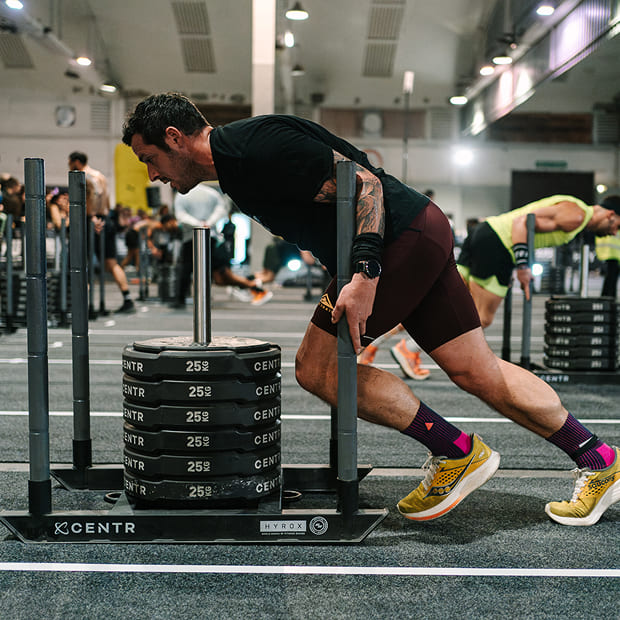
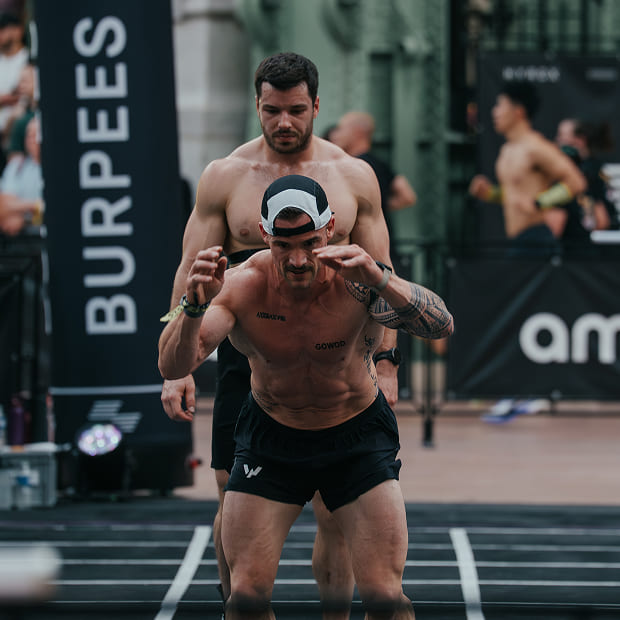
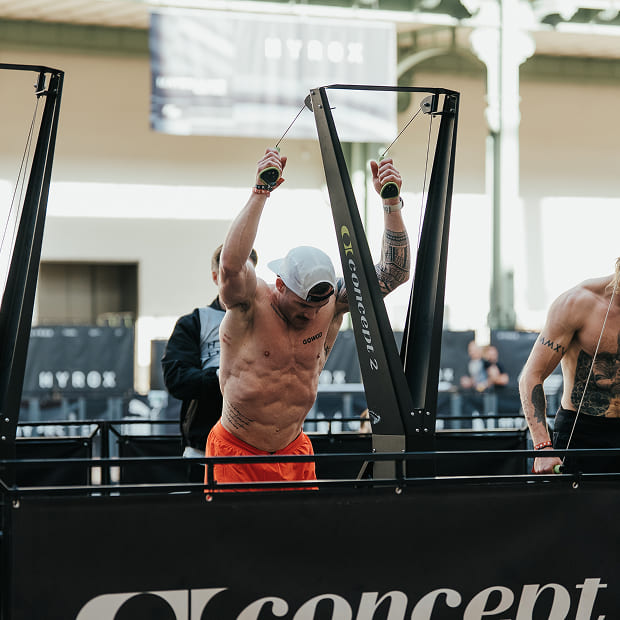
A HYROX® simulation is a race-day rehearsal that replicates the full competition format: 8 x 1km runs, each followed by one of the eight functional stations, completed in sequence. The goal is to experience the physical and strategic demands of the race before you actually do it.
Simulations are run by HYROX-affiliated gyms, CrossFit boxes, and hybrid training facilities. Some are large-scale events with waves, music, and an MC. Others are smaller group sessions where athletes work through the format together. The key difference from race day is that there is no official judging, no chip timing, and no competitive ranking. What you get instead is an honest read of your fitness, your pacing, and your ability to keep running after eight stations of functional work.
The hardest thing about HYROX is not any individual station. It is running after them.
After a sled push, your legs are burning. After burpee broad jumps, your lungs are at capacity. After the farmers carry, your grip and upper back are spent. Each 1km run in the back half of the race is what coaches refer to as compromised running: running under accumulated fatigue, when your body wants to stop, and your mechanics start to break down.
You cannot fully prepare for compromised running without actually experiencing it. A simulation puts you in that position before race day, so it is not a shock when it happens during the real thing. Athletes use simulations to:
Not every simulation replicates the full race. The format depends on where you are in your training block and what you are trying to get out of it.
A full simulation done 3 to 4 weeks before race day is the most common approach. This gives you enough time to recover fully and make adjustments to your strategy before the real event. Doing a simulation too close to race day risks arriving on the start line fatigued.
Optimize your performance, accelerate your recovery and prepare your body with personalized mobility training.
A race simulation is only as valuable as what you take from it. To get meaningful insights, approach it with intention and focus on the elements that will have the greatest impact on your performance.
The most common mistake in a simulation is treating it like a race. It is not. It is a data-gathering session. Going out hard on the first 1km and blowing up by Station 5 tells you very little about what you are capable of. Starting conservatively and finishing strong gives you a much clearer picture of your actual fitness and your limits.
A useful rule: if your first run feels easy, you are probably pacing it correctly.
The Roxzone is the transition zone between the running track and each station. How efficiently you move through it, slow down, find your equipment, and get started costs time that adds up across eight transitions. A simulation is a good opportunity to practice this without the pressure of race day.
Race day is not the time to try a new gel or figure out when to drink. Use the simulation to practice exactly what you plan to consume on race day: the same products, the same timing, the same quantities. If something does not work in a simulation, you have time to adjust.
Some stations have meaningful decisions attached to them. On the SkiErg and Row, do you go at a controlled pace or push harder? On Wall Balls, do you go unbroken or build in short rests? A simulation gives you a low-stakes environment to test different approaches and find out what actually works for you.
Many HYROX-affiliated gyms run regular simulation sessions. Some well-known examples include ONE LDN, which runs a full hybrid race simulation with a live DJ and MC, and CrossFit Putney, which runs wave-based simulation sessions with alternatives available where sled equipment is not accessible.
The Hybrid Athlete Club simulation finder lists upcoming HYROX simulations across multiple locations and is a good starting point for finding one near you. If there is nothing listed locally, your nearest HYROX-affiliated gym is worth asking directly. Many run sessions that are not publicly advertised.
Yes, if you have access to the right equipment. A full simulation requires a SkiErg, rowing machine, sled, and space for the carry and lunge stations. Many commercial gyms have SkiErgs and rowers. Sled access is less common and may require a specialist facility or a CrossFit box.
If you do not have access to a sled, some athletes substitute sled push and pull alternatives, such as a prowler push or heavy banded walk, to replicate the demand. This is not identical, but it is a practical workaround for training environments where sleds are not available.
Running a self-organised simulation works best with a training partner who can keep time, count reps, and hold you accountable to the same standards a judge would on race day.
A simulation is not a standalone training session. It sits within a broader preparation block that builds the fitness, strength, and movement capacity you need to perform well across all eight stations.
For all confirmed race dates and locations, the HYROX 2026 race calendar has the full season schedule.
A simulation places the same physical demands on your body as a real race. Arriving cold will cost you in the first two stations and give you an inaccurate read of what you are actually capable of.
The warm-up you use before a simulation should be the same one you plan to use on race day. This serves two purposes: it prepares your joints and muscles for the specific movement patterns coming up, and it lets you rehearse your pre-race routine so it feels automatic when it counts.
The pre-race activation guide covers six targeted movements built around the demands of HYROX, particularly the squat pattern, hip drive, and posterior chain. Running through it in the 15 minutes before your simulation wave is time well spent.
A simulation will expose weaknesses in your fitness, your pacing, and your movement. That is the point. Athletes who arrive at their first simulation already working on mobility exercises for the key HYROX movement patterns, particularly the squat, hip flexors, and posterior chain, tend to find the compromised running sections more manageable and recover faster in the days that follow. GOWOD builds personalized mobility routines based on your individual movement profile, so your preparation targets the ranges the race actually demands.
You’re only 3 steps away from unlocking your full potential.