The eight HYROX® stations are the SkiErg, Sled Push, Sled Pull, Burpee Broad Jumps, Rowing, Farmers Carry, Sandbag Lunges, and Wall Balls. They always appear in this order, and each one follows a 1km run.
Knowing the names and distances is a starting point. What separates athletes who have a good race from those who fall apart in the second half is a much deeper understanding of what each station actually demands, what the movement standards require, and how to approach each one when you are already tired.
For a broader overview of the race structure, including divisions, weights, and the full event day experience, the complete HYROX race guide covers that separately.
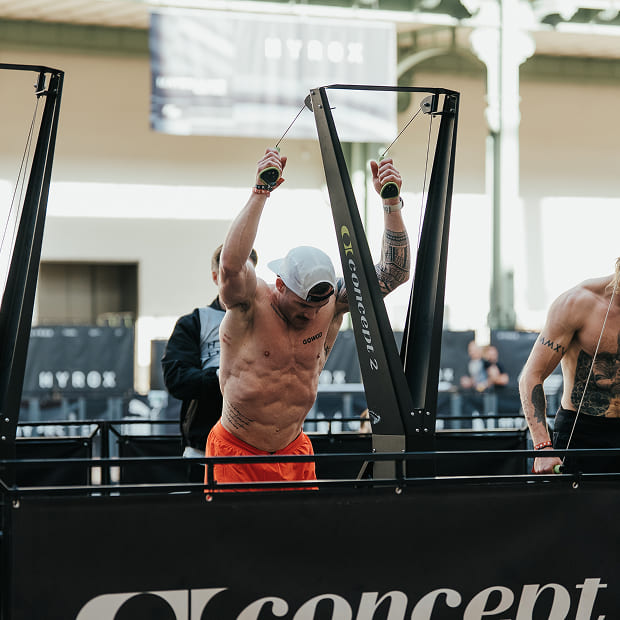
The SkiErg simulates the double-pole motion of cross-country skiing. You stand on a small platform, grip two overhead cables, and pull them down to your hips in a smooth, continuous rhythm. The machine measures distance, and you need to reach 1,000 metres before a judge confirms you can move on.
The resistance is preset to level 6 for all divisions, but you can adjust it as many times as you like. Most people leave it alone.
The SkiErg is mostly a cardiovascular station, but it loads the lats, shoulders, and core more than most first-timers expect. If your upper back is tight or your shoulder mobility is limited, the pull position will feel uncomfortable, especially as your heart rate climbs.
You arrive here straight off Run 1, so your heart rate is already up. Going too hard on the SkiErg pushes it higher before it has had a chance to settle, and you pay for that at Station 2 and beyond. Consistent overhead and shoulder mobility work in training helps you maintain a cleaner pull position without fighting your own body.
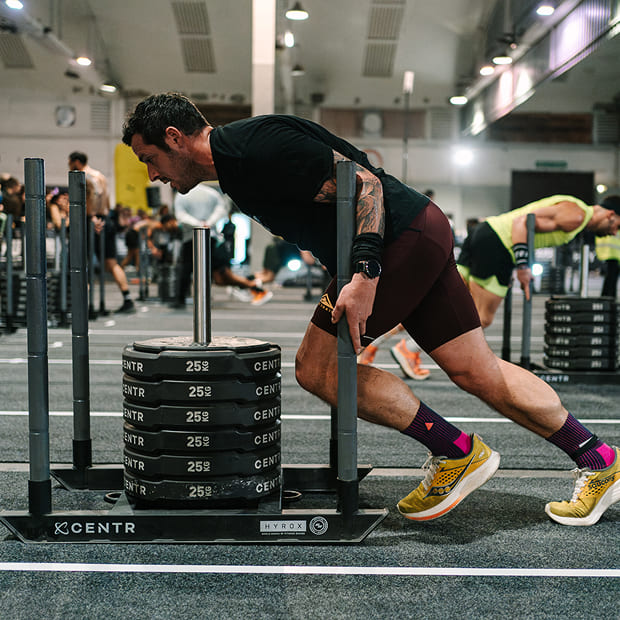
You push a heavy metal sled along a track for 50 metres total: four lengths of 12.5 metres. There are no wheels. The sled resists through friction with the floor, which means effort cannot be cheated. You have to drive every step.
The sled push is consistently underestimated. The friction resistance is unforgiving because there is no momentum to carry you. Every metre is earned with hip drive, calf push-off, and a forward body angle that puts real demand on the ankles.
Ankle dorsiflexion matters more here than most people realise. If your ankles are restricted, your body angle tends to rise to compensate, reducing your force angle and making the whole station harder than it needs to be. Calves take a significant load here, too. If you have a recurring issue with tightness, building the tight calves guide into your training week is worthwhile.
Same sled, same 50-metre distance, completely different movement. You face away from the sled and drag it toward you using a rope, pulling hand over hand while walking backwards. The rope must stay taut throughout.
While the sled push is leg-heavy, the sled pull shifts the primary load to the upper back, biceps, and grip. The hand-over-hand rope action is relentless over 50 metres. Forearm flexors take a beating here, and athletes who do not pace this station tend to arrive at the Farmers Carry with a grip that is already compromised.
The lower back stabilises throughout, and if your posterior chain is already working hard from the sled push, keeping good posture through the pull takes conscious effort. This is one of those stations where athletes with well-developed posterior chain strength and endurance quietly and without drama separate from the field.
Burpee Broad Jumps spike heart rate higher than any other station in the race. The combination of floor-to-standing and explosive horizontal jumping creates a cardiovascular demand that catches many athletes off guard, particularly at the midpoint of the race when fatigue is already building.
Hip mobility plays a direct role in the efficiency of the floor-to-jump transition. The explosive component of the broad jump relies on hip extension, and if the hip flexors are tight or have been fatigued by the earlier runs and sled work, that transition slows, and the jump loses power. Athletes who maintain good hip mobility through their preparation consistently find this station more manageable. The hip mobility guide is a useful resource to build into training well ahead of race day.
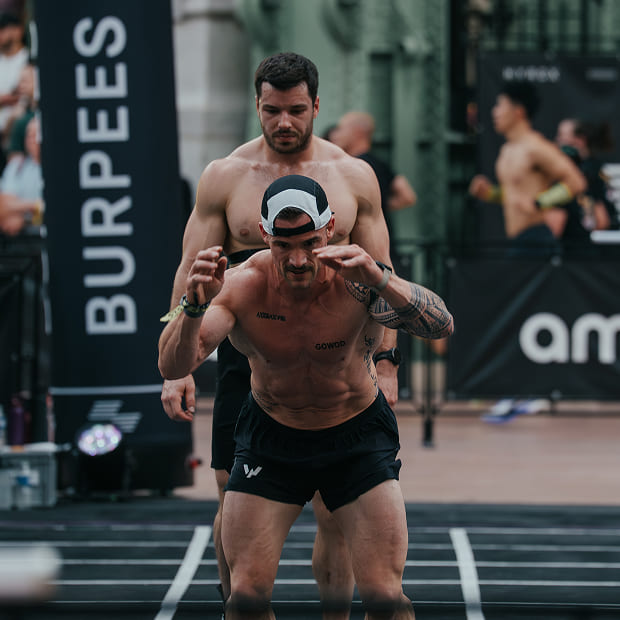
Each rep starts with a full burpee: chest to the ground, press up, then step or jump out. From there, you take a broad jump forward with both feet, land, and immediately start the next burpee. You continue for 80 metres. The length of each jump is your choice.
Burpee Broad Jumps spike heart rate higher than any other station in the race. The combination of floor-to-standing and explosive horizontal jumping creates a cardiovascular demand that catches many athletes off guard, particularly at the midpoint of the race when fatigue is already building.
Hip mobility plays a direct role in the efficiency of the floor-to-jump transition. The explosive component of the broad jump relies on hip extension, and if the hip flexors are tight or have been fatigued by the earlier runs and sled work, that transition slows and the jump loses power. Athletes who maintain good hip mobility through their preparation consistently find this station more manageable. The hip mobility guide is a useful resource to build into training well ahead of race day.
Optimize your performance, accelerate your recovery and prepare your body with personalized mobility training.
You row 1,000 metres on a Concept2 erg. The drive sequence is legs first, then back, then arms. The monitor and resistance are preset, though you can adjust the footplates to your preferred position before you start.
Rowing is often where athletes realise how much the first half of the race has cost them. By the time you sit down at Station 5, you have run 5km and pushed and pulled a sled. The legs that are supposed to drive the rowing stroke are already loaded, and many athletes end up compensating with their back and arms, which is a less efficient and more fatiguing way to row 1,000 metres.
Thoracic mobility has a real impact here. The catch position requires a forward hinge with a neutral spine. If the thoracic spine is stiff, you either shorten your stroke or round the lower back to get the reach, both of which add up over 1,000 metres. If lower back tightness is a pattern for you, the lower back stretches guide addresses the areas most likely to limit your rowing posture.
You carry two kettlebells, one in each hand, arms extended by your sides, for 200 metres. Depending on the venue, this may involve multiple laps. You pick the kettlebells up from a marked box at the start and return them to the same box at the finish, handles facing upright.
The Farmers Carry arrives after roughly an hour of racing for most athletes. Your grip has already been loaded by the SkiErg and sled pull. Your traps and upper back are carrying fatigue. And now you need to hold onto two heavy kettlebells and walk 200 metres with your posture intact.
The lower back and core stabilise throughout. As fatigue builds, athletes with limited hip extension or thoracic mobility tend to drift into a forward lean, shifting load from the legs and glutes onto the lumbar spine. Keeping that posture upright over 200 metres is less about strength than about mobility and body awareness. The lower back stretches guide covers the areas that matter most for this.
You carry a sandbag on your shoulders and lunge continuously for 100 metres, alternating legs with every step. You pick it up from a marked area before starting and return it afterwards. You cannot put it on the floor during the station.
Station 7 is where the race earns its reputation. By this point, you have run 7km and completed six stations. Your quads and hip flexors are at or close to their limit, and the sandbag lunge is asking them to work through a loaded, knee-to-floor range of motion for 100 metres.
Athletes who have not trained specifically for hip flexor and quad mobility tend to find the knee-to-floor standard genuinely difficult to maintain here. The trailing leg does not want to extend, the front hip does not want to open, and posture progressively deteriorates. The result is a slower station, more no-rep risk, and a worse experience than necessary.
Consistent work on thigh and hip flexor mobility in training, not just in the week before the race, directly changes how this station feels when everything else is already tired.
You squat while holding a medicine ball, then drive upward and throw it with both hands to strike a target on the wall at a specified height. You catch it, return to standing, squat again, repeat. 100 reps for all divisions. You must start each rep from a standing position with hips and knees extended. You cannot pick the ball up from the ground and throw it.
Wall Balls is the final station. It arrives after 8km of running and seven prior stations. And it demands clean squat mechanics at a point in the race when your legs, hips, and lungs are as tired as they have ever been.
The below-parallel depth standard is the thing that undoes people here. Athletes who cannot hit below parallel when rested will almost certainly not hit it at Station 8. Even athletes who can hit it will find their mechanics deteriorating as the quads, hips, and calves fatigue. The squat pattern needs ankle dorsiflexion, hip mobility, and thoracic extension working together, and when any one of those breaks down, the whole movement becomes less efficient, and the no-rep risk goes up.
This is not a station you can fake your way through. The GOWOD mobility exercises page covers the squat-specific ranges worth building in training. And before your race, the pre-race activation guide includes specific warm-up work for the squat pattern and hips.
Once you are done, the HYROX recovery guide covers what to do for the quads, calves, and hips that this station and everything before it have loaded significantly.
Optimize your performance, accelerate your recovery and prepare your body with personalized mobility training.
The eight stations are sequenced deliberately. Each one either compounds the fatigue from the previous one or briefly shifts the demand before returning to loaded lower-body work.
Understanding this sequence helps you pace each station correctly. The SkiErg and the Row are where going slightly conservative early pays the biggest dividends in the final third. The sled push and sled pull are where raw strength matters most, but where technique failures cost you most, too. Wall balls is where everything you did right or wrong earlier in the race becomes visible.
For more on the full race structure, including divisions, timing, and what to expect on the day, the complete HYROX race guide has the full picture. To find your next race, the HYROX 2026 race calendar has all confirmed events for the current season.
HYROX rewards athletes who have prepared their bodies to move well under fatigue, not just those who have trained hard. Every station in the race places a different demand on your joints and tissues, and by the time you reach Wall Balls, restrictions that felt manageable early on have a way of making themselves known. Consistent mobility exercises built around the squat pattern, hip flexors, posterior chain, and shoulders can make a measurable difference to how each station feels when it matters.
You’re only 3 steps away from unlocking your full potential.