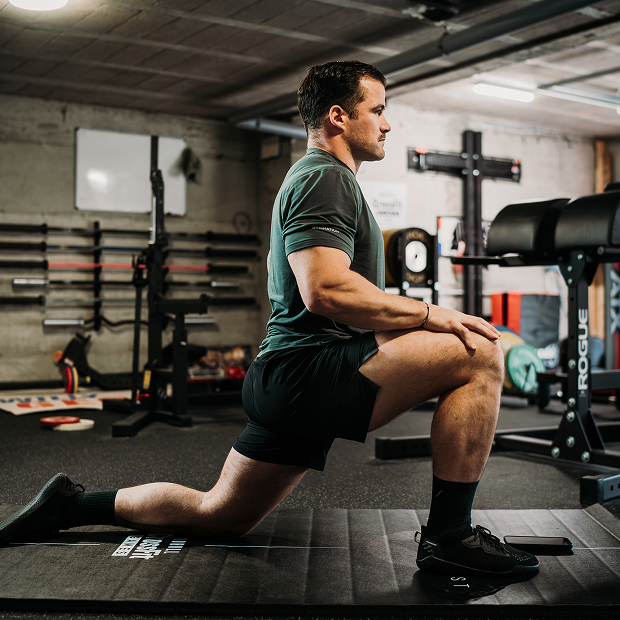
Sitting for long periods can lead to stiffness, reduced mobility, and discomfort in key areas such as the hips, spine, and shoulders. Over time, this may affect posture, movement quality, and even performance in training or daily life.
A structured mobility routine can help counteract these effects by restoring movement, improving joint function, and supporting better posture throughout the day.
Below, GOWOD has selected five expert-backed mobility exercises designed specifically for desk workers. These movements target the most commonly restricted areas from prolonged sitting and can be integrated into your daily routine with minimal time or equipment.
A mobility routine for desk workers should focus on opening the hips, improving spinal movement, and restoring upper body mobility:
Take our FREE mobility and flexibility test to identify your strengths and areas for improvement. In minutes, get a detailed breakdown of each body zone with insights and personalized guidance to progress.
Prolonged sitting is not just a passive posture. It creates a very specific mechanical environment that gradually reshapes how your body moves.
When you remain seated for hours, your joints are held in limited ranges of motion, particularly in hip flexion, spinal flexion, and internal shoulder rotation. Over time, your body adapts to these positions through a process known as tissue adaptation. Muscles, tendons, and joint capsules begin to tolerate and prefer these shortened or restricted ranges.
From a mobility perspective, this reduces your ability to access full, controlled ranges of motion when you need them. Key mechanisms at play include:
This is why many desk workers experience stiffness not just locally, but across multiple regions. The issue is rarely isolated. It is a system-wide reduction in movement capacity.
Prolonged sitting leads to predictable mobility restrictions throughout the body. Understanding these relationships helps explain why targeted mobility work is essential.
From a GOWOD perspective, these areas do not operate independently. Restrictions in one region directly influence movement quality in another. For example, limited hip rotation often leads to excessive lumbar rotation, which the lower back is not designed to handle repeatedly.
Mobility is often misunderstood as flexibility, but the key distinction is control.
Mobility refers to your ability to actively control a joint through its full available range. This has direct implications for both daily movement and athletic performance. For desk workers, reduced mobility may lead to:
From a performance standpoint, even outside of sport, this may affect how you walk, train, lift, or simply move throughout the day.
Research in movement science suggests that variability and access to multiple movement strategies are key to maintaining joint health and long-term function. Mobility work supports this by reintroducing controlled exposure to ranges that are otherwise neglected.
The most effective mobility strategy for desk workers is based on frequency and exposure, not intensity.
Your body adapts to what it experiences most often. If you spend most of your day in a restricted position, short, consistent mobility inputs are required to counterbalance it. A structured approach may include:
The goal is not to “stretch everything,” but to strategically expose your body to ranges it is currently lacking.
GOWOD’s approach is based on individual assessment, identifying where your specific mobility restrictions exist and prioritising those areas. By starting with a personalised assessment, you can focus on what your body actually needs rather than following a generic routine.
From there, you can access a full mobility library of guided exercises to build targeted routines that evolve with your progress. This ensures that the time you spend on mobility is not only efficient but directly relevant to how you move and perform.
What is the best mobility routine for desk workers?
The most effective routine is one that targets your specific restrictions. In most cases, this includes the hips, thoracic spine, and posterior chain. A personalised approach, such as GOWOD’s assessment-based system, ensures that you focus on the areas that will have the greatest impact.
Can mobility exercises reduce back pain from sitting?
Mobility work may help reduce stiffness and improve load distribution across the body. In many cases, lower back discomfort is linked to restrictions in the hips or thoracic spine, so addressing these areas may reduce unnecessary strain.
How long should a mobility routine take?
Effective routines do not need to be long. Consistent sessions of 5 to 15 minutes, performed regularly, are often more beneficial than occasional longer sessions. The focus should be on quality and relevance rather than duration.
Is it better to stretch in the morning or evening?
Both serve different purposes. Morning sessions may help prepare the body for movement, while evening sessions may support recovery and restore range after prolonged sitting. Including both can provide a more complete approach.
Do I need equipment for mobility training?
Most mobility work can be performed without equipment. However, tools such as resistance bands can be used to introduce additional stimulus, improve control, and access certain ranges more effectively.
If you’re spending long hours at a desk, a generic routine can help, but a personalised approach will take you further.
GOWOD analyzes your mobility, identifies your restrictions, and builds tailored routines tailored to your body and goals. Whether you’re looking to reduce stiffness, improve posture, or move better in training, having a structured plan makes the difference.
Download GOWOD now and start improving the way you move.
You’re only 3 steps away from unlocking your full potential.