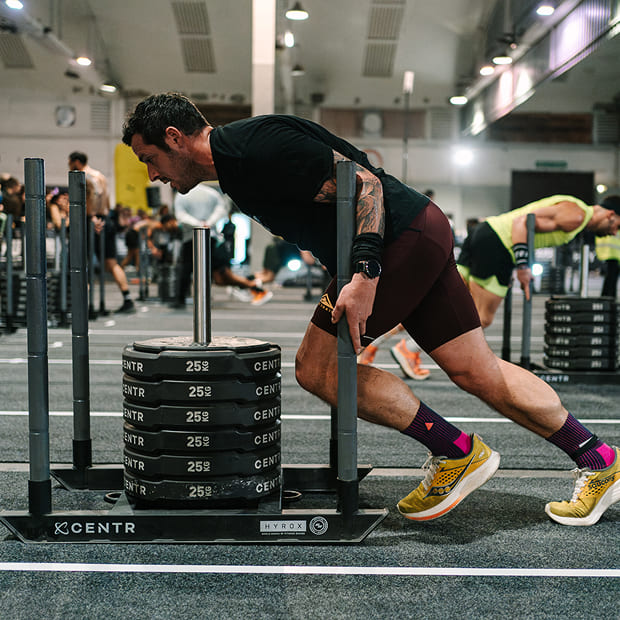
HYROX® Doubles is a two-person team format where both partners complete the full race together. Unlike a relay, neither partner sits the race out. Both athletes run every 1km segment, arrive at every station together, and share the work at each station using a You Go I Go format. The clock runs for the team from start to finish.
It is the same 8 x 1km run and 8 station structure as Singles, with the same fixed sequence and the same movement standards. The difference is in how the station workload is split and in the strict rule that partners must remain together throughout.
For a full breakdown of the race format and what each station involves, the complete HYROX race guide and the HYROX stations guide cover both in detail.
At each station, partners split the required reps or distance between them using a You Go I Go format. One partner works while the other rests, then they switch. They continue switching until the total required reps or distance is completed.
There are no rules on how the work is divided at each station. Partners choose their own split in the moment. Some pairs divide evenly: 500m each on the Row, 50 reps each on Wall Balls. Others play to their strengths, with one partner taking more of a station they are better at to preserve the other for later.
Example: 1,000m Row
The only rule is that the total required reps or distance must be completed before the team leaves the station. How the work is split within that is entirely up to the pair.
This is the rule that catches most Doubles teams off guard. Both partners must remain together at all times during the race, on the runs and at every station. The rulebook defines "remain together" as being no more than five seconds apart at any time.
The timing system monitors partner proximity automatically using chip reads. Every time the system detects that partners are more than five seconds apart, a 1-minute penalty is applied per infringement. A maximum of three penalties is allowed.
If a fourth infringement is recorded, the team is classified as Out of Competition and removed from the official rankings.
The practical implication of this rule is significant. The faster partner cannot run ahead to recover while the slower partner catches up. If one partner is having a bad run, the other must slow down to stay with them. Best practice from the rulebook is to stay within arm's reach of each other throughout the race.
Both partners must also:
There are five Doubles divisions, which differ by gender combination and weight.
Mixed Doubles uses Men's Open weights across all stations.
Optimize your performance, accelerate your recovery and prepare your body with personalized mobility training.
The station weights in Doubles are the same as the equivalent Singles division. Mixed Doubles follows Men's Open weights.
Age groups in Doubles are determined by the average age of the two partners on race day. If one partner is 36 and the other is 42, the average is 39 and the team competes in the 35-39 age group. Pro divisions end at the 55-59 age group. Athletes aged 60 and over compete in Open weight divisions regardless of fitness level.
This is one of the most common questions from athletes considering their first HYROX. The honest answer is: it depends on your strengths.
Doubles is generally more manageable cardiovascularly because You Go I Go gives each partner genuine rest within the stations. On a 1,000m Row, for example, each partner may only row 400 to 500 metres rather than the full distance. That recovery within the station is significant.
Where Doubles adds complexity is the stay-together rule on the runs. In Singles, the faster athlete can run their own pace. In Doubles, you run together, which means the pace of the pair is set by the slower partner on any given run. If there is a significant fitness gap between partners, this creates a real strategic challenge on the runs.
The result is that Doubles tends to reward pairs who are well-matched in running ability, even if one partner is stronger at certain stations.
The most important strategic decision in Doubles happens before race day: choosing your partner. A pair with similar running paces will be able to push the runs without risking penalties. A significant gap in running fitness means the stronger runner is constantly throttling back, which can be frustrating and difficult to manage over 8km.
Within stations, the most effective split is usually the one that keeps both partners fresh rather than the one that divides reps equally. If one partner is significantly better at Wall Balls, having them take 60 of the 100 reps while the other takes 40 is a legitimate strategy. The goal is total team performance, not equal effort at every station.
The runs are where Doubles races are most commonly lost. Going out too hard on the first few runs, particularly if one partner is the stronger runner and sets the pace, risks the slower partner falling behind and triggering penalties. Communicating clearly during the runs and running slightly conservatively early in the race is almost always the right call.
Both partners must enter and exit each station together. Smooth, practiced transitions save time across eight station changes. Teams who know exactly who starts each station and what the initial split looks like tend to transition faster than teams who make those decisions on the fly.
Both partners register individually at hyrox.com under the Doubles division for their chosen event. You select your division (Women's, Men's, Mixed, or Pro) and enter your personal details. The registration links the two partners as a team.
For all confirmed race dates and locations, the HYROX 2026 race calendar has the full season schedule.
Doubles times are generally faster than Singles because of the recovery built into the You Go I Go station format. What constitutes a good time varies significantly by division, fitness level, and partner dynamic.
In Doubles, both partners need to be prepared to move well through all eight stations, not just the ones they plan to take the majority of. Stations arrived at with fatigued mechanics place both partners at risk of no-reps and lost time. Mobility exercises for the key HYROX patterns, particularly the squat, hip extension, and posterior chain, benefit both partners regardless of how the station split is divided. GOWOD builds personalized mobility routines based on each athlete's individual movement profile, so preparation is targeted to what each partner actually needs rather than a generic programme.
You’re only 3 steps away from unlocking your full potential.