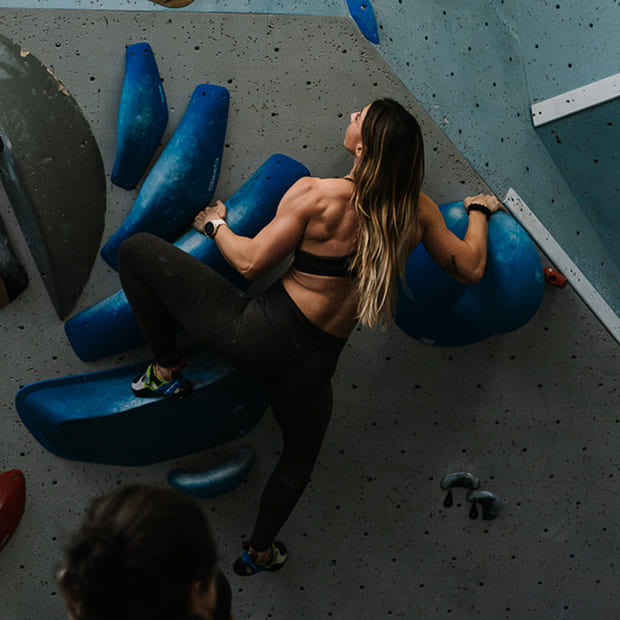
Most climbers hit a point where progress stalls, and the instinctive response is to train harder or get stronger. That's rarely the actual bottleneck once you're past the total beginner stage. If you've been searching for how to improve at bouldering without just grinding out more sessions, the answer usually isn't more training volume; it's training the right things. Technique, movement efficiency, and mobility tend to matter more for breaking a plateau than raw pulling strength, and training the wrong thing is a big part of why some climbers spend months stuck at the same grade.
Past the earliest stages, many climbers already have enough strength to complete the moves on problems a grade or two above their current level. What actually separates climbers who progress from those who plateau is movement efficiency: using your feet, hips, and body positioning to keep as much of your weight as possible off your arms, rather than relying on grip strength to compensate for poor positioning.
A climber with excellent technique uses noticeably less energy per move than one relying on strength, which means they arrive at the crux of a problem with more in reserve. Chasing more finger or pulling strength without addressing positioning and efficiency tends to produce diminishing returns, since you're adding capacity to compensate for inefficiency rather than removing the inefficiency itself.
These aren't about training harder. They're about training the things that are genuinely holding most intermediate climbers back.
Spend time looking at a problem and planning your sequence (which hand and foot goes where, and in what order) before you attempt it. Look at the angle of the wall, the type of holds involved, and where a rest position might be partway through, rather than just the holds you can see from the ground.
If other climbers are working the same problem, watching a few attempts, or simply asking what beta they used, can save you several attempts of trial and error, and most climbers are happy to share what worked for them.
Staff at the gym are also a good resource if you're stuck on a specific move and can't tell why it isn't working. Climbers who default to figuring it out move by move on the wall, without this groundwork, tend to waste energy on wrong turns and hesitation that a bit of planning and a quick conversation would have avoided.
Efficiency doesn't improve much just by climbing more; it improves when you deliberately practice moving better. Drills like climbing with silent feet (placing them with control rather than stomping or scraping), climbing an easy problem in slow motion, or down-climbing a problem instead of just jumping off at the top, all force you to notice and correct small inefficiencies that don't show up when you're climbing at your limit and focused purely on not falling off.
Filming yourself on video occasionally is another useful way to spot habits you can't feel from the inside, like a hip that isn't rotating into the wall or a foot placed slightly wrong. Pick one or two of these drills and build them into your warm-up on easy problems, rather than saving efficiency work for when you're already tired from harder attempts.
Bouldering heavily loads your finger and forearm flexors (the muscles that close your grip), while the wrist extensors on the back of your forearm work mainly isometrically to stabilize the wrist. A mismatch between the load placed on these tissues and their capacity to tolerate it is thought to be one contributing factor, among others like overall climbing volume and how quickly you've progressed your training, in the elbow pain some climbers develop on either the inner or outer side of the elbow (colloquially grouped as climber's elbow), depending on which tendons are under the most strain.
How to Prevent Elbow Pain in Bouldering goes into this in more depth if it's something you're already dealing with. Wrist extensor exercises, such as slowly lifting a light weight with your palm facing down for controlled repetitions, are commonly recommended to help address this imbalance, starting light and progressing gradually. If you already have any elbow pain, get that checked by a physiotherapist before adding a new loading exercise: this isn’t a substitute for individual assessment.
Hip flexion and external rotation (for high steps), hip internal rotation (for drop knees), shoulder flexion and thoracic extension (for full reaches), and ankle dorsiflexion (for smearing and precise foot placement) can all be limiting factors that are sometimes mistaken for strength deficits.
If a high step feels physically impossible rather than just hard, that can point toward a hip mobility limitation rather than a pulling strength one, though hip and core strength to control the leg through that range plays a role too. Either way, getting stronger at pulling with your arms won't fix it. 7 Stretches to Help With Tight Hips and Hip Mobility is a useful starting point, since hip mobility is one of the most common limiters for climbers working on higher steps and drop knees.
Fingers and connective tissue adapt more slowly than muscle does, and progressing too fast on climbing volume or intensity is one of the most common ways intermediate climbers develop an overuse injury that then forces a much longer break than the rest they were avoiding.
In practice, this means treating your week as a mix of intensities rather than maximal effort every session: one or two genuinely hard sessions where you push your limit, balanced against lighter sessions on easier problems or technique drills, and at least one full rest day. If your fingertips feel consistently tender, or a specific tendon or joint feels achy rather than just generally tired, that's a signal to take an extra light session or rest day rather than pushing through it.
Spending all your time on problems you can already complete builds confidence but not new capability. Regularly attempting problems that are currently too hard, and working them over multiple sessions, is what actually exposes and improves your weaknesses, since these are the problems that force you into positions your current technique and mobility can't yet handle comfortably.
Rather than repeatedly attempting a hard problem from the start, break it into individual moves or sections first, practice the specific move that's stopping you in isolation, and only link the whole sequence together once each part feels solid. Keep a note of what's actually stopping you on each attempt (a specific hold, a body position, a moment of hesitation), since that tells you exactly what to work on rather than just trying again and hoping it goes differently.
Most climbers gravitate toward problems built around holds that suit their existing strengths, whether that's crimps, slopers, pinches, or volumes, and quietly avoid the ones they're weaker on. This feels more productive in the moment, since you send more problems, but it leaves a genuine gap in your climbing that shows up as soon as you hit a problem built around your weaker hold type. Deliberately seeking out problems that use the hold type you like least is one of the more direct ways to close that gap.
A real part of plateauing at a grade is hesitation to commit to dynamic or exposed moves, not a lack of physical capability to actually do them. This is a distinct limiter from strength, technique, or mobility, and no amount of training the physical side will fix a habit of backing off right before the crux. Practicing dynamic or committing moves on easier problems first, close to the pad, and getting comfortable with falling in a controlled way builds the confidence that lets you commit fully on harder problems where hesitation is what actually causes the fall.
Take our FREE mobility and flexibility test to identify your strengths and areas for improvement. In minutes, get a detailed breakdown of each body zone with insights and personalized guidance to progress.
Fingerboard (or hangboard) training, where you hang from small edges to build finger strength, is a well-established tool for advanced climbers, but it’s also a frequent cause of injury in intermediate climbers who introduce it too early or progress the load too quickly.
Building a solid base of pain-free climbing volume first, and progressing fingerboard load conservatively once you do start, likely matters more than the specific protocol you follow. If you have any history of finger or elbow pain, it's worth getting that assessed by a physiotherapist before adding fingerboard training on top of your regular climbing.
Do I need a fingerboard to get better at bouldering?
No, particularly at beginner to intermediate levels. Technique, movement efficiency, and mobility typically offer more room for improvement than finger strength at this stage, and fingerboard training carries a real injury risk if introduced before you have a solid climbing base.
How do I break through a bouldering plateau?
Look honestly at whether the limiter is actually strength, or whether it's technique, movement efficiency, or a specific mobility restriction. Past the beginner stage, many plateaus come down to one of the latter three, not a lack of raw pulling power.
Is climbing every day bad for progress?
It can be, particularly for your fingers and connective tissue, which adapt more slowly than your cardiovascular system or general fitness does. Building in genuinely lighter sessions or full rest days reduces the risk of an overuse injury derailing your progress altogether.
What should a weekly training split actually look like?
A common approach is one or two harder sessions focused on projecting near your limit, one lighter technique-focused session, and at least one full rest day, adjusted based on how your fingers and joints are feeling rather than followed rigidly regardless of how you feel.
Should I train outdoors as well as indoors?
Outdoor climbing exposes you to different hold shapes, textures, and movement demands than an indoor gym setter tends to create, which is genuinely useful for well-rounded progress. It's worth trying once you're comfortable with gym basics, ideally with someone experienced the first few times, since outdoor problems don't come with the same clear safety markings and padding as an indoor gym.
Ready to train the mobility that's actually holding you back?
A lot of bouldering plateaus can come down to a hip, shoulder, or ankle range you can’t access yet, not a lack of strength. The GOWOD app includes mobility routines built around exactly these climbing-specific demands, so you can train what's actually limiting you.
Download GOWOD and start closing the mobility gaps holding your climbing back.
You’re only 3 steps away from unlocking your full potential.