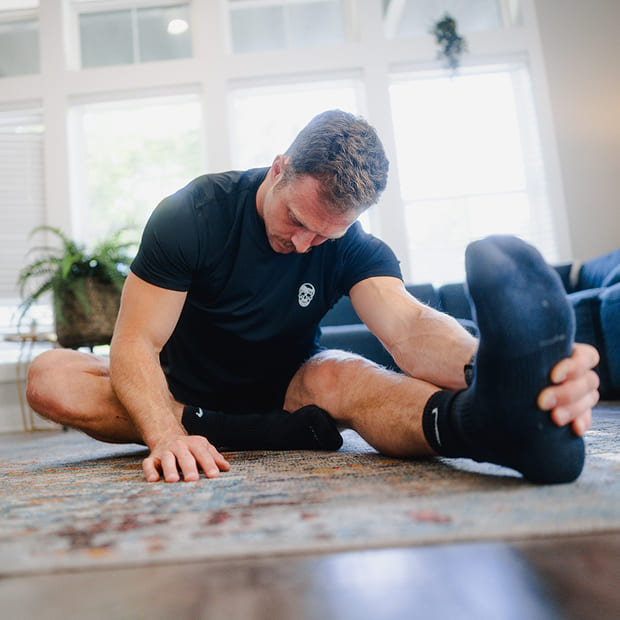
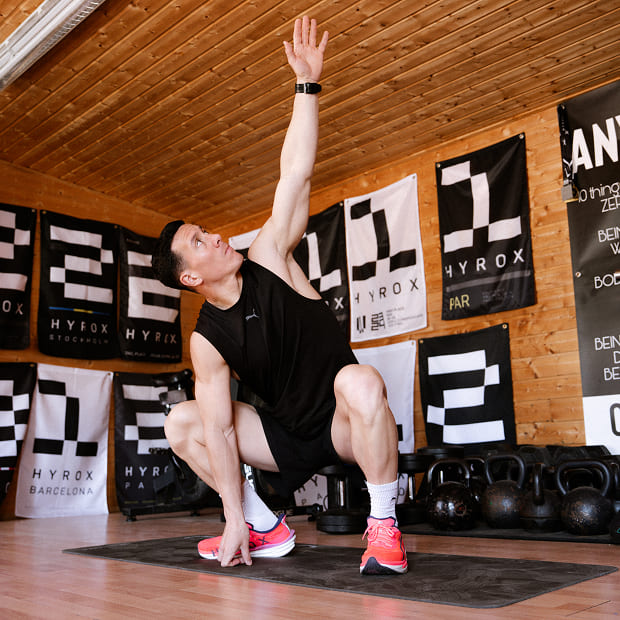
Trail running places unique demands on your body. Uneven terrain, steep climbs, technical descents, and constant changes in direction require more than just cardiovascular fitness. You need ankle stability, hip control, eccentric strength, and rotational mobility to move efficiently and reduce unnecessary strain.
The right mobility routine can help you prepare for the instability of trails, handle the impact of downhill running, and maintain strong running mechanics as fatigue sets in. Below are five essential stretches and activation drills selected by GOWOD to support trail performance and long-term durability.
Trail running is a sport that requires not only great endurance and a strong mindset, but also the ability to absorb impact on uneven terrain. For that, your body, joints, and muscles must be prepared before every race.
Here are the top mobility exercises you should know and perform as a trail runner.
Trail running exposes movement limitations far more quickly than road running. On the road, stride patterns are repetitive and predictable. On the trail, every step demands adaptation. Rocks, roots, cambers, steep ascents, and aggressive descents require constant adjustments at the ankle, knee, and hip. When mobility or control is lacking, compensation happens immediately.
The most common underlying contributors we see in trail runners include:
Mobility is not a substitute for strength. It is the foundation that allows strength to express itself efficiently. When joints have a usable range of motion and muscles can lengthen and contract under control, force is distributed more evenly. The result is a stride that is more economical, more stable, and more resilient over long distances.
This is precisely why trail runners benefit from structured, sport-specific mobility rather than generic stretching routines.
Take our FREE mobility and flexibility test to identify your strengths and areas for improvement. In minutes, get a detailed breakdown of each body zone with insights and personalized guidance to progress.
Trail running performance is built on precise lower limb coordination. Every step requires the ankle, knee, hip, and pelvis to work together under load, often at speed and on unstable ground. When these regions move well and share force effectively, you get smoother transitions, better control on descents, and a more efficient uphill drive.
Here is how each key region contributes to trail-specific performance:
The body rarely fails in isolation. When one joint lacks usable range or control, another region absorbs the excess demand.
For example, limited ankle mobility often increases stress at the knee. Restricted hip rotation can shift load into the lumbar spine. Over time, these compensations accumulate. What starts as stiffness after a long run can develop into recurring tightness, loss of efficiency, or persistent irritation.
This is why targeted mobility is not about flexibility for its own sake. It is about restoring a balanced distribution of forces across the kinetic chain, so trail runners can move with control, durability, and confidence over unpredictable terrain.
As fatigue accumulates during a long trail run, joint control typically declines before aerobic capacity does. Ankles lose stiffness and responsiveness, stride mechanics become less precise, and hip rotation reduces. Small losses in range or control compound over thousands of steps, especially on technical terrain.
This is where structured mobility becomes performance-relevant. Improved joint range paired with active control supports:
At GOWOD, we see consistently that athletes who train mobility with intention maintain cleaner mechanics deeper into sessions and races. The goal is not to become more flexible. It is to maintain usable range and joint control when the terrain becomes unpredictable, and fatigue sets in.
Recovery for trail runners is not passive. It is about restoring joint quality, maintaining a usable range of motion, and preparing tissues to tolerate repeated eccentric load.
Because trail terrain creates high variability in stress, your mobility work should also be structured and intentional across the week. Mobility can be integrated at key points within your training cycle:
This is precisely where the GOWOD mobility assessment becomes valuable. Instead of guessing where you are tight, the assessment identifies whether your primary restriction sits in the ankles, hips, shoulders, or elsewhere. Your sessions are then built around your actual limitations, not assumptions.
Mobility should also be supported by complementary recovery strategies:
Mobility is most effective when it is consistent, assessed, and progressive. Random stretching provides temporary relief. Structured mobility, aligned with your training demands, supports durability across an entire trail season.
Generic stretching routines do not account for how you move, where you compensate, or which joints are limiting your performance on technical terrain. GOWOD takes a different approach.
Through our mobility assessment, we identify your specific restrictions in key regions, such as the ankles, hips, and shoulders. Your sessions are then built around your individual profile, targeting the limitations that most strongly influence your trail-running mechanics.
This means you are not simply following a list of stretches. You are working on the exact ranges that affect your stability on descents, your efficiency on climbs, and your control under fatigue.
For trail runners who want to move with precision and durability across unpredictable terrain, mobility should be personalised, progressive, and performance-driven. That is what GOWOD is designed to deliver.
Should trail runners stretch before every run?
Dynamic mobility work is commonly used before trail runs to prepare the ankles, hips, and calves for uneven terrain. Long static stretching is generally better suited for post-run recovery sessions.
Why do my calves feel tight after downhill running?
Downhill running increases eccentric load on the calves. They lengthen under tension to control descent, which can lead to stiffness if not properly prepared or recovered.
Is hip mobility important for trail running?
Yes. Trail terrain requires constant rotational adjustments. Limited hip mobility can lead to compensations in the knee or lower back.
Can mobility work reduce knee pain from trail running?
Improving ankle dorsiflexion, quad control, and hip stability often supports better knee alignment. While it is not a standalone solution, mobility is commonly part of a broader strategy.
How often should trail runners do mobility training?
Many active runners benefit from short sessions several times per week. Consistency tends to be more important than session length.
You’re only 3 steps away from unlocking your full potential.