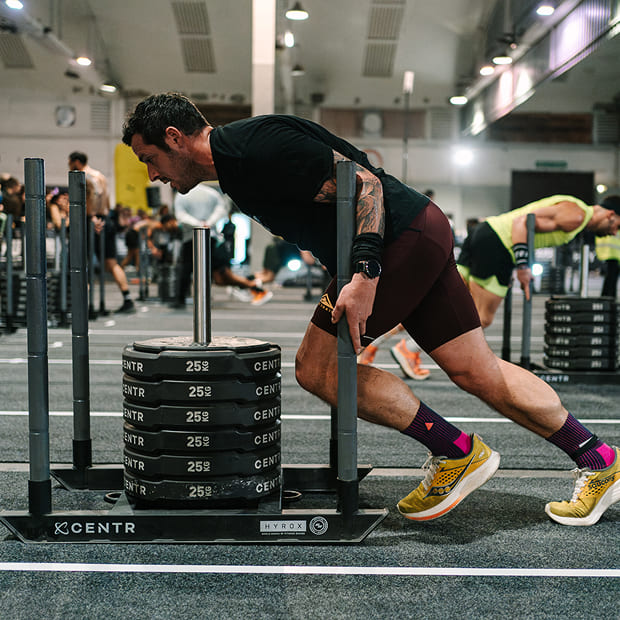
The HYROX® sled weight depends on your division, and the figures in the official rulebook are total weights inclusive of the sled itself. There are two sled stations in every HYROX race: the Sled Push and the Sled Pull. They use the same sled but with different total weights, and both are covered below.
There are two sled stations in HYROX: the Sled Push and the Sled Pull. They use the same sled but with different total weights.
The Sled Pull is lighter than the Sled Push across all divisions. This reflects the mechanical difference between the two movements: pushing a sled against friction requires more force than dragging it using a rope with your body weight as an anchor.
Optimize your performance, accelerate your recovery and prepare your body with personalized mobility training.
The weights listed above are the total loaded weight you are moving, not the weight added on top of the sled. HYROX does not publish the sled's own base weight separately, so you cannot work backwards to find out exactly how much plate weight is loaded on top.
What matters on race day is the total resistance you are working against, and those are the figures above. When you step up to your assigned lane, the sled is already set to the correct weight for your division. It is your responsibility to confirm you are at the right lane and using the correct sled.
The sled has no wheels. It moves through friction resistance against the floor surface, which means every kilogram of the total weight translates directly into resistance you have to overcome with each step. There is no momentum to carry you. If you stop, you start from zero again.
This is what makes the Sled Push one of the most physically honest stations in HYROX. The full breakdown of the Sled Push and all other stations covers the movement standards, common mistakes, and how to approach each one strategically.
For more detail on the Sled Push distance specifically, the article [how far is the sled push in HYROX] covers the 50-metre format, the four-length structure, and what that means for pacing.
The Sled Push is Station 2 and the Sled Pull is Station 3. They follow each other back to back with only a 1km run in between, which means your legs are already carrying fatigue from the push when the pull begins. The pull then loads your grip, upper back, and biceps before you move into Burpee Broad Jumps.
Understanding where the sled stations sit within the full race sequence, and how fatigue from one station compounds into the next, is covered in the complete HYROX race guide.
In HYROX Doubles, the sled weights are the same as Singles for the equivalent division. Mixed Doubles uses Men's Open weights for both the Sled Push (152kg) and Sled Pull (103kg).
The friction-based resistance of the sled rewards athletes with strong hip drive, ankle mobility, and the ability to maintain a forward body angle under load. Calf strength and ankle dorsiflexion have a direct influence on the Sled Push in particular. When ankle range is limited, the body angle rises to compensate, reducing force efficiency and making the station harder than it needs to be.
If you are looking for your next event, the HYROX 2026 race calendar has all confirmed dates and locations for the current season.
The sled stations place a specific demand on the posterior chain, calves, and ankles that does not show up in standard gym training. Athletes who follow regular mobility exercises targeting ankle dorsiflexion, hip extension, and posterior chain flexibility tend to find both sled stations noticeably more manageable on race day. GOWOD builds personalized mobility routines based on your individual movement profile, so the preparation you do is targeted to the ranges the sled stations actually demand.
You’re only 3 steps away from unlocking your full potential.