A HYROX® race consists of 8 x 1km runs, each immediately followed by one of eight functional workout stations, completed in a fixed sequence. Every athlete runs the same course, performs the same stations in the same order, and races against the clock. The total running distance is 8km. There is no break between the run and the station, and no break between the station and the next run.
That combination of sustained aerobic effort and repeated strength work is what makes HYROX different from a standard running race or a gym-based fitness competition. By the time you reach the final stations, you are not just tired from lifting. You are tired from running, from lunging, from pushing. Everything compounds.
If you are looking for upcoming events to enter, the HYROX 2026 race calendar covers all confirmed dates and locations.
The race follows a fixed sequence of eight runs and eight stations. Run 1 always precedes Station 1, Run 2 always precedes Station 2, and so on. Athletes cannot skip ahead, complete stations out of order, or return to a station. Violations result in penalties or disqualification.
Most athletes finish in approximately 1.5 hours, though times vary considerably by division and experience level. You can find finish times and race results on the HYROX website.
Optimize your performance, accelerate your recovery and prepare your body with personalized mobility training.
The SkiErg is a cable-based machine that mimics the double-pole motion of cross-country skiing. You stand facing the machine and pull two handles down simultaneously in a controlled, rhythmic movement.
It is the first station after the first run, which means you arrive with your heart rate already elevated. The main demand here is cardiovascular. Most athletes settle into a steady pace rather than sprinting, knowing there are seven more stations ahead.
Key muscles involved: lats, shoulders, core, hip flexors. Athletes with limited thoracic mobility or shoulder range often find the pulling position uncomfortable under fatigue. Keeping the shoulders and upper back mobile supports a more efficient pull pattern throughout the race.
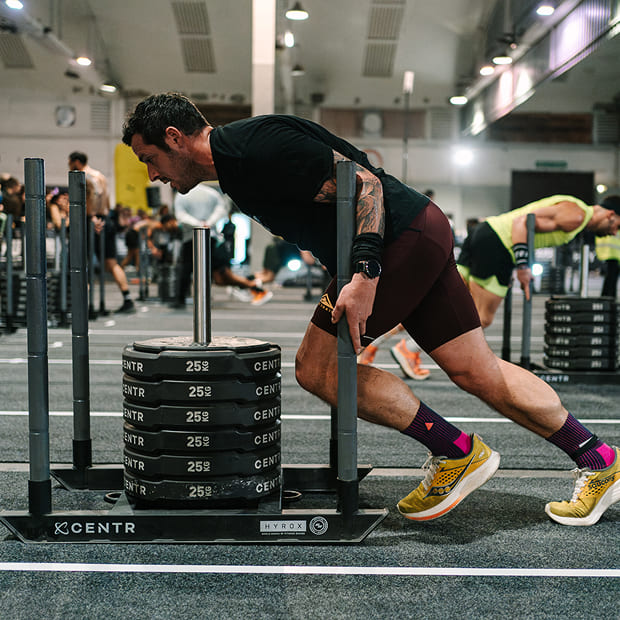
You push a weighted sled along a track for 50 metres. The sled has no wheels. Friction resistance means you must drive hard into the ground with each step.
The push begins immediately after Run 2, which means your legs are already carrying fatigue. The station demands a strong forward lean, powerful hip extension, and ankle drive. Tight calves or restricted ankle mobility can significantly reduce your ability to generate the push-off needed here. If your calves are a recurring issue, the tight calves guide covers practical release and mobility work for this exact area.
Additional notes on the sled push:
The sled pull follows the same 50-metre format, but now you face away from the sled and drag it toward you using a rope, hand over hand. This is a fundamentally different movement pattern to the push: your upper back, biceps, and grip carry the primary load.
Because your hips are in a more neutral position during the pull, the posterior chain demand shifts compared to the push. Athletes who have carried upper body fatigue from the SkiErg often notice it here.
Additional notes on the sled pull:
You perform a standard burpee, but instead of jumping vertically, each rep finishes with a horizontal broad jump forward. You continue for 80 metres total.
This is commonly one of the most demanding stations for cardiovascular recovery. The floor-to-stand-to-jump pattern is highly taxing on the hips, quads, and lungs. Because it follows the fourth run, you are approaching the midpoint of the race and fatigue is accumulating rapidly.
Hip mobility has a direct influence on how efficiently you can move from the floor position to the jump. Athletes who work consistently on hip mobility tend to maintain a cleaner, less effortful movement pattern late in this station.
You row 1,000 metres on a Concept2 rowing machine. The drive comes from leg push, followed by a back swing, followed by an arm pull. Rowing after four runs and three strength stations tests your ability to maintain power output when already fatigued.
Thoracic and hip mobility play an important role here. Restricted movement through the thoracic spine limits how far you can hinge forward at the catch position, reducing your effective stroke length and making each metre more energy-intensive.
You carry two kettlebells or dumbbells, one in each hand, for 200 metres. The load is carried at your sides with arms extended. You cannot put them down until you complete the full distance.
This is the longest station in the race by distance and places significant demand on grip, trap strength, and postural stability. Your ability to stay upright and keep your shoulders packed directly affects how well you carry into the next run.
Lower back stiffness or restricted hip extension will make this 200 metres feel considerably harder than it should. The lower back stretches guide has practical options that address this area directly.
You carry a sandbag on your shoulders and lunge for 100 metres, alternating legs with each step. This is the only station that combines loaded lower-body movement with forward progress simultaneously.
By Station 7, you have already run 7km, pushed a sled, pulled a sled, rowed, and carried kettlebells. Your quads, hip flexors, and glutes are under significant accumulated strain. Maintaining a neutral pelvis and an upright torso while lunging requires hip flexor mobility and quad length that many athletes have not specifically trained for.
Working on tight thigh and hip flexor mobility in preparation can meaningfully change how this station feels on race day.
Additional notes on sandbag lunges:
You squat holding a medicine ball, then drive up and throw the ball to hit a target on the wall at a prescribed height. The ball must hit the target. You catch it, squat again, and repeat.
Wall balls are the final station of the race. By this point, you have run 8km and completed seven other stations. The squat pattern demands ankle dorsiflexion, hip mobility, and thoracic extension, and it becomes significantly harder to maintain cleanly under extreme fatigue. Athletes with hip or ankle restrictions often see their squat mechanics collapse here, making each rep slower and more demanding.
The number of reps differs by division. Pro divisions perform 100 reps. Open divisions perform 100 reps. Wall ball height also varies by division and gender.
After the final wall ball, there is no further run. The race ends at the completion of Station 8.
Optimize your performance, accelerate your recovery and prepare your body with personalized mobility training.
HYROX offers four competition divisions. Weights differ per station and per division. Age group athletes compete within their division's weight standards.
All weights listed include the weight of the sled itself, where applicable. The SkiErg, Burpee Broad Jumps, and Rowing have no additional load and are identical across all divisions.
Within each division, athletes are placed into age group categories. These determine how your finishing time is ranked for podium and World Championship qualification purposes. Categories run in five-year bands.
Athletes aged 60 and over compete with Open division weights regardless of their fitness level. They remain eligible for Age Group World Championship qualification, but cannot enter the Pro division. This means a 62-year-old competing at a very high level will still use Open division weights on the sled, kettlebells, sandbag, and wall ball.
Your time starts when you cross the start line and stops when you complete your final wall ball rep. Timing chips are worn on the ankle and must remain on throughout the race. Athletes who remove or lose their chip may be disqualified.
Penalties can be applied up to 48 hours after the race finishes. These are typically issued for movement standard violations caught on video review, such as arriving at a station without completing the required run, or failing to meet the prescribed standard for a repetition. Penalty time is added to your final result, not served on course.
Wave starts are used at most HYROX events. Athletes start in groups, but your chip time is your actual race time regardless of which wave you started in. This allows direct comparison across athletes who started at different times.
Singles is the standard format. One athlete completes the full race alone.
Double pairs two athletes who alternate who runs and who performs each station. When one partner is running, the other waits at the station. Partners must stay within 5 seconds of each other throughout the race. Double pairs can be same-sex or mixed. Mixed Doubles use Men's Open weights.
Relay uses four athletes, who divide the runs and stations between them. Teams can organise their athlete order however they choose, within the fixed transition zone rules.
How the Doubles format actually works in practice, including partner strategy and pacing, is covered in detail in the How Does HYROX Doubles Work guide.

Understanding the race format is one thing. Knowing what the day actually looks like from the moment you arrive is another, and for first-time HYROX athletes, especially, the event experience can feel overwhelming if you go in without a picture of it.
HYROX events are held in large indoor venues, typically convention centres, exhibition halls, and sports arenas. Because races run over multiple days with waves starting throughout each day, the venue operates continuously rather than as a single mass start. Athletes arriving for an afternoon wave will pass athletes who finished hours earlier, and the energy in the building tends to reflect that layered intensity.
Most events recommend arriving at least 60 to 90 minutes before your wave start time. This gives you enough time to go through bag check and security, find your way to race registration, collect your bib and timing chip, locate your bag drop and changing rooms, and warm up properly before heading to the start corral.
Security and bag check procedures vary by venue. Some events use a simple bag drop, while others, particularly larger venues, operate a more formal security screening process. Clear or small bags tend to move through faster. Always check the specific event details in advance: the HYROX 2026 race calendar includes venue-specific information for each event where available.
Most HYROX events provide a consistent set of on-site facilities, though the exact setup depends on the venue. As a general guide, you can expect:
Because venues differ, not all of the above will be available at every event. It is always worth checking in advance rather than assuming.
Arriving early enough to warm up is not just a scheduling nicety. It directly affects how your first two stations feel.
HYROX begins with a 1km run immediately followed by the SkiErg. If you step onto the course cold, your heart rate spike in that first run will be steeper, and your early stations will feel harder than they need to. A proper warm-up gradually raises your heart rate, activates the muscles you are about to load, and prepares your joints for the squat, hinge, and push patterns ahead.
The pre-race activation guide covers exactly what to do in the warm-up window: six targeted movements that address the specific joint demands of HYROX, particularly for wall balls, sled work, and the running segments. Running through those in the warm-up area before entering the corral takes around 10 to 15 minutes and is time well spent.
Athletes enter the start area in their assigned wave. Waves are typically grouped by division and sometimes by predicted finish time. Your wave number and start time will be confirmed in the race information sent out before the event.
Because chip timing is used, you race your own clock regardless of when your wave goes. There is no advantage in being at the front of your wave if you are likely to get caught in a bottleneck at the first station. Most experienced HYROX athletes will tell you that the opening 1km is the easiest place to blow your race by going out too fast.
The course is set up inside the venue. Running sections loop around the perimeter, while stations are arranged in the central floor area. This means spectators and other athletes are visible throughout, creating an atmosphere noticeably different from a traditional road race.
HYROX events are known for their energy. Music plays throughout. Commentators call out names and finish times. Other athletes are completing their own races around you. People who finished hours ago may still be watching from the spectator areas or cooling down near the recovery zones.
This environment affects performance in ways that are easy to underestimate. The noise and activity can push you to go harder than is sensible early on. The crowd near the finish can carry you through the final wall balls when your legs want to stop. If you respond well to that kind of atmosphere, HYROX tends to deliver it consistently across events.
You cross the finish line after completing your final wall ball rep. There is no run after Station 8. The clock stops, your chip is read, and your official time is recorded.
At most events, you will receive your official HYROX finisher patch after crossing the line. Results, including your overall time, station splits, and age group and division ranking, are published on the HYROX results platform and typically available within a short window of your finish.
Penalties, if any, can be applied to your result up to 48 hours after the race. If a movement standard violation was recorded on video, penalty time will be added to your chip time before your final result is confirmed.
Running 8km alone would be a substantial workout. Performing eight strength stations in isolation would also be a substantial workout. HYROX combines both, and the order is deliberate. Each station is placed so that the fatigue from one component compounds into the next.
The sled push taxes the legs before the sled pull taxes the upper body. Burpee broad jumps spike heart rate just before the row requires you to produce power from a seated position. The farmers carry pre-fatigued the grip and traps before the sandbag lunge loads the hips and quads. Wall balls arrive last, when very little is left.
What this means practically is that you need more than cardiovascular fitness and strength. You need mobility. When your hips can move freely through a full squat under fatigue, your wall balls stay efficient. When your ankles have adequate range, your sled push maintains its drive angle. When your thoracic spine can extend, your row does not become a lower back exercise. The GOWOD mobility exercises page is a good starting point for building the specific joint ranges HYROX demands, particularly around the squat pattern, posterior chain, and shoulder positions.
On race day itself, how you arrive matters as much as how you have trained. Going in cold will cost you in the first two stations and set the wrong tone for everything that follows. The HYROX pre-race activation guide is built around the specific demands of a HYROX race and takes around 10 to 15 minutes in the warm-up area before your wave.
Athletes who treat mobility as a structured part of their HYROX preparation rather than an afterthought tend to notice the difference most in the final two stations, when everyone else's mechanics are beginning to break down. The same logic applies after the race. The HYROX recovery guide targets the exact muscle groups the race loads most, and working through it within a few hours of finishing will make the following morning considerably less painful.
To find an event near you, the HYROX 2026 race calendar has all confirmed dates and locations for the current season.
Good luck and have fun!
You’re only 3 steps away from unlocking your full potential.