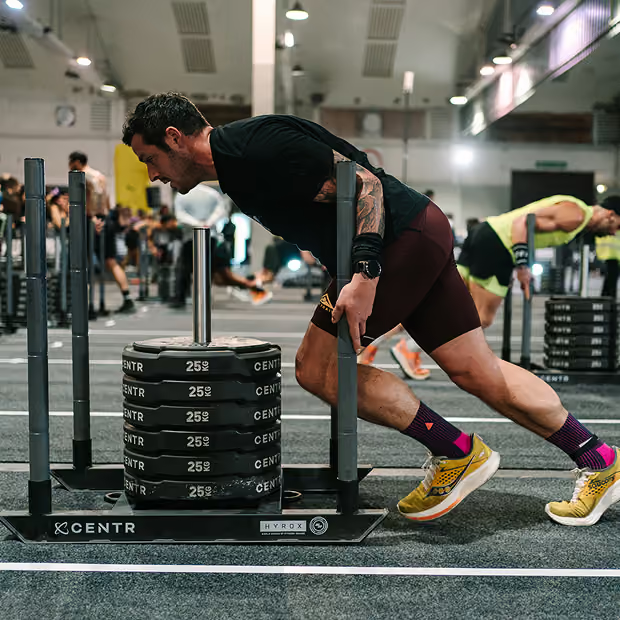
The HYROX® Sled Push covers a total distance of 50 metres, split into four lengths of 12.5 metres each. The athlete pushes the sled to the end of the lane, changes direction, and pushes back. This is repeated until four full lengths have been completed.
The station is complete once the athlete has finished all four lengths and the entire sled has passed the line.
The weights below are the total weight including the sled itself. The sled frame is not lightweight, so the load added on top is less than these totals suggest. However, the total weight the athlete is pushing is what is listed here.
What the sled actually feels like
One thing athletes who have only trained on gym floors or turf are frequently surprised by is how the sled feels on competition day. HYROX venues use a high-friction carpet surface that creates significantly more resistance than a smooth floor. The sled will feel heavier than the same weight does in training. If your only sled work has been on a gym floor, factoring this in before race day is worth doing.
A penalty of 3 minutes applies for each incomplete lane. The penalty protocol for other infringements follows the standard HYROX structure: a formal warning on the first infringement, a 15-second penalty on the second, with each subsequent infringement adding another 15 seconds.
The Sled Push rewards a specific body position. Getting it wrong costs both speed and energy.
Stay low throughout. The most common mistake at this station is standing too upright. A more upright position reduces power transfer from the legs and places more strain on the lower back and shoulders. The drive position should feel athletic: hips back, chest forward, a strong forward lean through the body from head to heel.
Use the shoulders as an anchor, not the arms. Press your shoulders firmly into the handles and lock the arms straight. The power comes from the legs driving through the floor. The arms transmit that force into the sled rather than generating force themselves. Athletes who try to push with their arms fatigue their upper body quickly and lose the most efficient transfer of power.
Short, powerful steps. Long strides reduce leverage and are less efficient for this movement. Short, rapid steps keep the body in the optimal drive position and allow more continuous force through the sled.
Keep moving. Stopping mid-push and restarting requires a disproportionate amount of energy compared to maintaining continuous movement, even at a reduced pace. If you need to slow down, slow down. Do not stop.
The Sled Push is Station 2, which arrives relatively early in the race. The temptation to go out hard on the first 12.5m is real and usually costly. Athletes who push too aggressively in the first section often find the third and fourth lengths significantly harder than expected, compounding fatigue going into Run 3 and the Sled Pull.
A controlled, sustainable effort across all four lengths consistently produces better times than an all-out start followed by a forced slowdown.
Arriving at the Sled Push as Station 2 means the body is relatively fresh, but this can be deceptive. The heavy load and high-friction surface generate a rapid rise in heart rate and significant lactate accumulation. That cardiovascular and muscular cost carries into Run 3 and the Sled Pull immediately after. How you manage the Sled Push has a direct effect on your condition for the next two segments.
For a full breakdown of all eight stations and how the race builds, the HYROX stations guide and the complete race guide cover everything in detail.
In Doubles, the resting partner must walk immediately behind the working partner throughout the push. The resting partner must not stand in front of the sled, obstruct neighbouring lanes, or assist with pushing. If the resting partner's movement obstructs other athletes, it is treated as an infringement.
In Relay, the Relay Member assigned to Station 2 completes the full 50 metres alone.
The Sled Push places its heaviest demand on the quads, glutes, hamstrings, and core across four lengths of sustained pushing. The quadriceps drive knee extension during each step, the glutes and hamstrings extend the hip, and the core stabilises the forward lean position throughout. The drive position also requires the ability to maintain a strong forward lean without lower back compensation, which is primarily a thoracic extension capacity issue: athletes who lack thoracic extension tend to hyperextend the lumbar spine instead, reducing efficiency and increasing lower back load.
Before the race, targeted activation of the glutes, quads, and thoracic extensors helps prepare the body for the demands of this station. The pre-race activation guide covers the full warm-up sequence for race day.
After the race, the quads, glutes, and lower back carry the most accumulated load from this station. The post-race recovery guide covers what to do in the hours after finishing. Thigh stretches targeting the quads and lower back mobility work are both relevant for recovery from this station specifically.
Mobility exercises targeting hip extension, thoracic extension, and the posterior chain build the foundation for a stronger, more sustainable drive position. GOWOD builds personalized routines based on your individual movement profile, so the work you do in training targets what your body actually needs.
You’re only 3 steps away from unlocking your full potential.