September 21, 2026

What to pack for HYROX

The best way to build a HYROX® packing list is to work backwards from the race itself. Eight 1km runs. Eight workout stations. A timing chip on your ankle. A start time written on your arm. A bag drop you will not see again until it is all over.

When you think about what the race actually demands at each stage, from check-in through to the finish line and the journey home, the list builds itself.

This guide covers everything: the mandatory items you cannot race without, the gear that supports each station, nutrition, warm-up and recovery kit, what to bring if you are travelling to the event, and the non-obvious additions that experienced athletes swear by.

For a full breakdown of what happens at each station, the HYROX stations guide and the complete race guide are worth reading before race day.

The essentials: what you cannot race without

These are the items that determine whether you start. No exceptions.

  • Government-issued photo ID. Required at check-in to collect your timing chip and wristband. A driver's license or passport works. A phone photo of your ID does not.

  • Registration confirmation. Your booking reference, either printed or on your phone. Have it accessible before you join the check-in queue.

  • Running shoes. Closed-toe shoes are mandatory throughout the race, except at the Wall Ball station where you are permitted to remove them. More on shoe choice below.

  • Your start time written clearly on your arm. HYROX requires your official start time to be clearly visible on your arm during the race. In practice this is done with a permanent marker, either at check-in or by the athlete beforehand. You can usually sort this at the venue, but having a marker in your bag means you are not hunting for one on a busy race morning.

What to wear on the course

Shoes

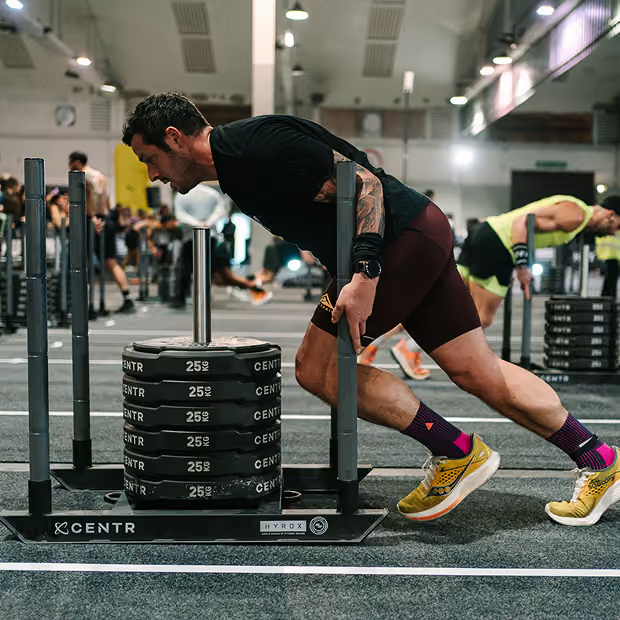
Your shoes are the single most consequential kit decision you make. HYROX combines sustained running with loaded carries, sled pushing and pulling, and lunging under load. No single shoe is perfect for every element.

Most athletes race in a versatile training shoe rather than a dedicated road racing flat. The reasoning: a racing flat optimizes for running efficiency but offers little support under the lateral and loading demands of the stations. A training shoe handles both adequately. If you have been training in a specific shoe, race in that shoe. Race day is not the time to debut new footwear.

Key considerations:

  • A wider toe box helps on the Burpee Broad Jump, where foot stability on landing matters.

  • Sufficient heel drop and cushioning protect the Achilles and calves across 8km of running on a hard indoor surface.

  • Grip matters less than on outdoor courses, but a completely flat racing shoe can slip on the sled lane surface.

At the Wall Ball station, you are permitted to remove your shoes. Many athletes do this to improve squat depth and foot proprioception. If you plan to, wear socks that you are comfortable standing and squatting in.

Socks

Compression socks or calf sleeves are popular and legal. They offer modest support during the running segments and may reduce the calf tightness that builds over the back half of the race. If you use them in training, wear them in the race. If you do not, do not introduce them on race day.

One practical consideration specific to HYROX: your timing chip is worn on the ankle for the entire race. A mid-calf sock with a secure cuff reduces friction between the ankle strap and your skin over 8km of running. If you are prone to ankle irritation, this is worth thinking about when you choose your socks.

Regardless of compression, bring a spare pair of socks in your bag. If your feet are wet or blistered post-race, fresh socks on the journey home matter more than you think.

Race kit

Wear what you train in. Shorts with a liner work well given the range of movement required. Avoid anything with pockets that could catch on the sled rope or create drag on the Burpee Broad Jump.

For women, a supportive sports bra that works for both running and loaded overhead movement is worth thinking about specifically. The SkiErg and Wall Balls both involve overhead reach, and a bra that restricts that range will affect your position at the catch.

Pack a warm-up layer you are happy to shed at the start pen. HYROX venues are large indoor arenas and the temperature before your wave can be significantly colder than it is mid-race. A zip-top or hoodie that you can leave with your bag before the start keeps your muscles warm during the wait without adding weight to your race kit.

Station-specific gear

The following items are all permitted under the HYROX rulebook. Whether you bring them is a personal choice, but each one has a legitimate reason to be in your bag.

Knee sleeves

Useful across multiple stations: the Sled Push and Pull place significant compressive load through the knees, and the Sandbag Lunges involve 100 metres of repeated knee-to-floor contact. If you train with knee sleeves, race with them. If you do not, they are unlikely to help and may feel restrictive.

Note: if you choose to wear knee sleeves or any other permitted item, the rulebook requires you to wear them from the start of the race to the finish. You cannot put them on or take them off mid-race, and you cannot receive them from anyone once the race has started.

Weightlifting belt

Most relevant for the Farmers Carry and the Sled Push. The belt adds intra-abdominal pressure during heavily loaded movements, which supports the lumbar spine. If you use one regularly in training, bring it. If you have never trained with one, do not put it on for the first time on race day.

The same rule applies as knee sleeves: if you start with it, you finish with it.

Gloves

The rulebook permits gloves but not grips. The Sled Pull, Farmers Carry, and SkiErg are the stations where hand protection is most relevant. Athletes with sensitive hands or existing callus tears often find gloves worthwhile for the Sled Pull in particular, where rope grip over 50 metres creates significant friction.

Thin, close-fitting gloves that allow for feel on the bar are preferable to thick padded options that reduce grip sensitivity.

Wristbands

Wristbands serve a practical purpose: they keep sweat off the hands during the SkiErg and Wall Balls. Thin sweatbands are sufficient. Some athletes use them more for habit and comfort than performance benefit.

Hydration pack or belt

Water is available at aid stations around the Roxzone, but you cannot accept drinks from spectators or anyone outside the official aid stations. If you want to hydrate more frequently or carry electrolytes, a hydration pack or running belt is permitted. Keep it minimal: extra weight carried for 8km of running adds up.

TAKING PART IN HYROX THIS YEAR?

Optimize your performance, accelerate your recovery and prepare your body with personalized mobility training.

What NOT to bring onto the course

The following are strictly forbidden under the HYROX rulebook and will result in confiscation or penalties:

  • Headphones or earphones of any kind.

  • Cell phones (unless you have prior written approval from the Race Director for a medical device).

  • GoPro cameras or any body-mounted cameras.

  • VR headsets.

  • Helmets or breathing apparatus.

On chalk: Athletes who train at CrossFit or weightlifting gyms are used to chalking up freely. At HYROX, you cannot bring your own. The event provides chalk at certain stations, and you are only permitted to use it there. Using chalk at any other station, including chalk you have brought yourself, incurs a 2-minute penalty per infringement. Leave your chalk at home.

Nutrition and hydration

HYROX is a race of typically 60 to 100 minutes for most athletes. At that duration, nutrition strategy matters but does not need to be complicated.

Before the race

A familiar pre-race meal two to three hours before your start time is enough for most athletes. Avoid experimenting with new foods or supplements on race day. Whatever has worked before a hard training session will work here.

During the race

Any nutrition you want to carry must be on your person from the start of the race. You cannot receive food or drinks from spectators or supporters during the event. This is treated as outside assistance and carries a 3-minute penalty per infringement.

Practical options to carry:

  • Gels. The most practical format: small, light, and fast to consume between a run and a station. One gel every 25 to 30 minutes is a reasonable approach for most athletes.

  • Chews. Slower to consume than gels but easier on the stomach for some athletes.

  • Electrolyte tablets or powder. The aid stations provide water, but electrolytes are not guaranteed. A dissolvable tablet in the water bottle on your hydration belt is a simple solution.

Avoid anything that requires chewing mid-effort or creates a choking risk. Bars and solid food belong in the warmup, not on the course.

After the race

Plan your post-race nutrition before you arrive at the event, not after. You will finish depleted, and the food options near most HYROX venues are variable. A protein shake and a bag of snacks in your holdall means you are not relying on whatever is available outside the venue when you are exhausted and hungry.

Warmup and recovery kit

Warmup

HYROX provides a designated warm-up area with equipment relevant to the race. You do not need to bring your own kettlebells or rower. What you might want to bring:

  • Resistance bands. Useful for hip and shoulder activation before the race. Light, compact, and take up no space.

  • Lacrosse ball or massage ball. For targeted soft tissue work on the calves, glutes, or foot before you warm up. More practical than a foam roller in a busy venue.

  • Foam roller. If you have the bag space and you use one regularly, it earns its place in your kit bag for the warm-up and for post-race.

Headphones are worth packing for the warm-up. They are strictly forbidden during the race itself, but many athletes use them before their wave to manage nerves and focus. Leave them with your bag before you enter the start pen.

Have the GOWOD app downloaded and open before you arrive at the venue. The warm-up area is where you want to run your pre-race activation routine, and the post-race recovery routine is the first thing you will want once you have changed. Both are quick, guided, and worth doing rather than guessing. The pre-race activation guide and post-race recovery guide are also available to read anytime.

Post-race recovery

  • Change of clothes. A dry top, loose bottoms, and fresh socks are worth prioritising over everything else in your bag. You will be grateful for them within about four minutes of finishing.

  • Slides or sandals. Your feet will thank you for not putting running shoes back on immediately after the race.

  • Recovery snacks. As above: plan ahead and bring your own.

For post-race movement work, the recovery stretches guide covers what to do in the hours after the race to start the recovery process.

If you are travelling to the event

HYROX events are held in major cities worldwide, and many athletes travel specifically to race. If you are staying overnight or travelling a significant distance, the list extends.

The night before

  • Earplugs and a sleep mask. Hotels near large event venues are often noisy. You have paid months of training to be ready for this race. Protect your sleep.

  • A familiar pre-race meal you can cook or order. Do not leave your pre-race nutrition to chance in an unfamiliar city. Know what you are eating the night before and the morning of the race, and have a plan for both.

  • Your kit laid out and checked the night before. Go through the complete packing list before you sleep, not the morning of the race.

On the day

  • A permanent marker. You need your start time visible on your arm. Hotels and event venues may not reliably have these available when you need one.

  • Printed or downloaded registration confirmation. Do not rely on mobile signal at a venue with thousands of other athletes. Download it offline or print it.

  • Your race bag with a change of clothes. You will be checking a bag at the venue. Make sure everything you need post-race is in it before you hand it over.

Getting there and back

  • Compression garments for the journey home. If you are on a long drive or train home after the race, compression tights or socks reduce the stiffness and swelling that sets in over a long journey with fatigued legs.

  • A wet bag for your post-race kit. A dedicated wet bag for your sweaty race kit keeps it away from your clean clothes and everything else in your holdall. Built for Athletes make a popular one that has become something of a fixture at HYROX events, but any waterproof drawstring bag works.

  • Snacks for the journey. Train stations and motorway service stations at the end of a race day are not the place you want to be making your recovery nutrition decisions. Pack food for the return journey before you leave.

The small things that make a difference on race day

These are the items that do not appear on most packing lists but come up repeatedly among experienced HYROX athletes.

  • A GPS watch. HYROX provides timing splits via the ankle chip, but a watch on your wrist gives you real-time pace data across the eight runs. Pacing is one of the most common sources of lost time at every level, and being able to see your pace on Run 1 before the damage is done is genuinely useful. Use what you train with. Race day is not the time to set up a new device. As with nasal strips, GPS watches are not explicitly listed among the permitted accessories in the HYROX rulebook, though they are ubiquitous at events and worn without issue. If you want to be certain, check with your event's Race Director in advance.

  • Nasal strips. Increasingly visible in HYROX starting pens, they improve nasal airflow mechanically, which matters when you are sustaining effort across 60 to 100 minutes in a warm indoor venue. Worth trying in training first to make sure they stay on through sweat. One caveat: the HYROX rulebook lists only seven permitted accessories and nasal strips are not among them. Any item not explicitly listed is technically prohibited by default. In practice, they are widely used without issue, but if you plan to race with them, it is worth confirming with the Race Director at your specific event before race day.

  • Anti-chafe cream. Eight kilometres of running plus loaded carries creates sustained friction in the usual places. Body Glide, Vaseline, or a similar product applied before the race prevents the kind of chafing that turns a great race into a miserable journey home.

  • Blister plasters. Even in well-fitted shoes you have trained in, the combination of indoor surface, prolonged effort, and sweat creates blister conditions. A small pack in your bag costs nothing and has saved many a post-race journey.

  • Baby wipes. Chalk residue from the Sled Pull and Farmers Carry stations, sweat, and general post-race grime. A small pack in your change of clothes bag is one of those things you will use every single time.

  • A small towel. Most HYROX venues do not provide towels. Useful during warmup, at the aid stations, and post-race.

  • A small zip-lock bag for your gels. Carrying gels loose in shorts or a hydration belt means fumbling for them mid-run. A small zip-lock bag tucked into your waistband keeps them together and accessible without taking up space.

  • A portable charger. Your phone battery will take a hit from navigation, photography, and the post-race results checking. A small power bank is worth the weight in your holdall.

The complete HYROX race day gear list:

Race essentials

  • Government-issued photo ID.
  • Registration confirmation (printed or downloaded offline).
  • Running shoes (trained-in, not new).
  • Race kit: shorts, top, sports bra if applicable.
  • Mid-calf socks (to reduce timing chip friction), plus a spare pair.
  • Warm-up layer to shed at the start pen.

Station gear (as relevant to you)

  • Knee sleeves.
  • Weightlifting belt.
  • Gloves (not grips).
  • Wristbands.
  • Hydration pack or belt.
  • GPS watch (for pacing the runs).

Nutrition

  • Pre-race meal ingredients or plan.
  • Gels and/or chews for the race.
  • Electrolyte tablets or powder.
  • Post-race protein and snacks.
  • Snacks for the journey home.

Warmup and recovery

  • Resistance bands.
  • Lacrosse or massage ball.
  • Foam roller (optional, bag space permitting).
  • Headphones for warmup (not for the race).
  • GOWOD app downloaded and ready.
  • Change of clothes: top, bottoms, fresh socks.
  • Slides or sandals.
  • Small towel.

Travel additions

  • Earplugs and sleep mask (for the night before).
  • Compression garments for the journey home.
  • Wet bag for post-race kit.
  • Portable phone charger.

The non-obvious extras

  • GPS watch (if not already packed above).
  • Nasal strips.
  • Anti-chafe cream.
  • Blister plasters.
  • Baby wipes.
  • Small zip-lock bag for gels.

Getting your body ready before you pack your bag

The kit list above covers what goes in the bag. What does not go in the bag is the preparation that actually determines how you move through eight stations on race day. Restricted ankle mobility costs you on the Wall Balls and on the runs. Limited hip extension costs you on the Sandbag Lunges. Thoracic restriction costs you on the SkiErg.

Mobility exercises targeting the key HYROX patterns, the squat, hip hinge, lunge, and posterior chain, build the movement quality that holds up under race fatigue. GOWOD builds personalized routines based on your individual movement profile, so the work you do in training is targeted at what your body actually needs. That preparation belongs in the weeks and months before race day, not in the warm-up tunnel.

The pre-race activation guide and post-race recovery guide are both worth having saved before race day so you are not searching for them when you need them.

UNLOCK YOUR BODY

Start your journey to better mobility

You’re only 3 steps away from unlocking your full potential.

  • Download the GOWOD App
  • Take your assessment
  • Improve your mobility one stretch at a time with GOWOD Premium
Three smart phones depicting GOWOD app interfaces. From Left to right: a guided workout of the Samson Stretch with a built-in timer, a personalized dashboard with mobility scores and statistics, and the opening screen of the GOWOD app.

Resources

EMPIEZA HOY
Descarga la app GOWOD
Descargar