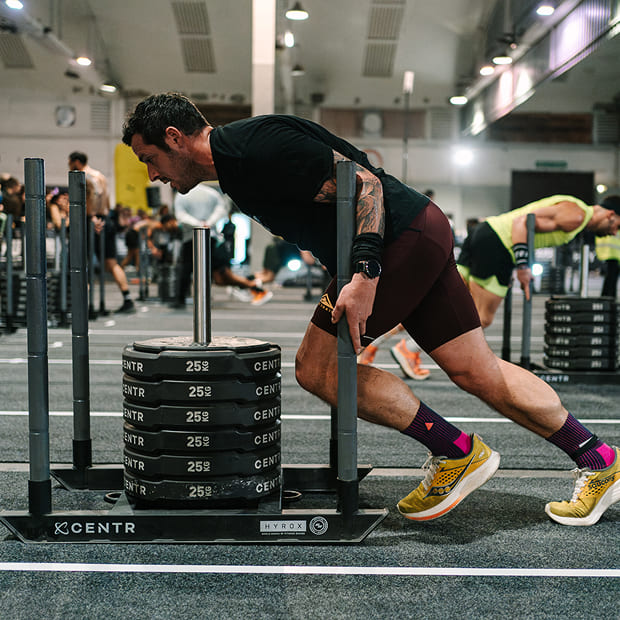
HYROX® is one of those events where the finish line means something different to everyone who crosses it. For some, a good time is one that lands them on the podium or earns a spot at the World Championships. For others, a good time is simply finishing without stopping, completing the Wall Balls without a no-rep, or beating what they ran last season.
Both of those are legitimate answers. The benchmarks below are useful for orientation, but the most honest framing is this: a good HYROX time is one that represents the best you were capable of on that day.
That said, having a realistic sense of where you sit relative to the field is genuinely useful for setting goals, pacing your race, and tracking progress over time. So here is a full breakdown by division, followed by practical ways to find time on the course.
Before getting into numbers, it is worth understanding what actually drives finish times in HYROX.
Experience matters enormously. First-timers almost always leave time on the course, not because they are unfit, but because they have never managed the transitions, paced eight consecutive 1km runs, or felt what it is like to hit the Wall Balls with 8km of running already in the legs. A second or third race at the same fitness level will almost always produce a faster time.
Division affects everything. Men's Open and Women's Open carry different weights across six of the eight stations. Pro divisions carry significantly heavier loads. Comparing a Men's Open time to a Women's Open time, or either to a Pro time, tells you very little.
Age group matters. Average times tend to slow gradually from age 40 onwards. What is competitive in the 35-39 age group looks different from what is competitive in the 50-54 age group.
Your goal matters most. If you are a first-timer whose goal is to cross the finish line, then crossing the finish line is a good time. If you are a seasoned athlete targeting a World Championship qualification spot, the benchmark shifts entirely.
The average Men's Open finish time sits at around 1:35:00. Breaking 1:30:00 as a first-timer is a strong result. Breaking 1:15:00 puts you in genuinely competitive territory for age group podiums at most events.
The average Women's Open finish time is around 1:38:00. Breaking 1:30:00 represents a strong performance. Sub-1:15:00 is elite-level territory.
Pro divisions use heavier weights across the stations, which adds meaningful time compared to Open for the same level of athlete. As a rough guide, expect Pro finish times to run approximately 10 to 15 minutes slower than Open times at an equivalent fitness level.
The very best Pro athletes in the world are in a different category entirely.
Men's Pro world record: Alexander Roncevic holds the current record at 51:59, set at the Warsaw Major in April 2026, making him the first man to break the 52-minute barrier. This beat the previous record of 52:42 set just weeks earlier by Hidde Weersma at HYROX London Olympia, where Weersma had himself become the first man under 53 minutes. The standard at the very top of the sport is moving fast.
Women's Pro world record: Joanna Wietrzyk holds the women's Pro record at 54:25, also set at the Warsaw Major in April 2026. The performance completed an unprecedented Grand Slam of Elite 15 Major victories across the 25/26 season.
Men's Open world record: Alexander Roncevic also holds the Men's Open record at 50:38, set in Cologne in April 2024.
Women's Open world record: Lauren Weeks set the Women's Open record at 55:38 in Washington DC in March 2025.
Records and times cited above reflect the official standings as of publication (July 2026). HYROX world records are broken frequently as the sport grows and elite competition intensifies. Please check HYROX's official results pages before relying on these figures for anything time-sensitive, as they may have already been superseded.
Doubles times are generally faster than Singles, because the You Go I Go format at each station builds genuine recovery into the race. Each partner is working for less total time at the stations, which preserves more in the legs for the runs.
The stay-together rule on the runs, however, means the pair moves at the slower partner's pace. This often limits how much time Doubles teams gain on the running segments compared to what each individual might run alone.
For context on what elite Doubles looks like, here are the current world records across the main Doubles divisions:
Men's Pro Doubles: Alexander Roncevic and Tim Wenisch set the record at 47:41 at the EMEA Championships in London in March 2026.
Women's Pro Doubles: Lauren Weeks and Vivian Tafuto hold the record at 52:11, set at the Warsaw Major in April 2026. It was the fourth time the pair had raced together and the fourth time they had broken the record.
Men's Open Doubles: Jake Williamson and Fabi Eisenlauer set the record at 47:57 in Berlin in 2025.
Women's Open Doubles: Meg Martin and Calypso Sheridan hold the record at 53:21, set in Brisbane in April 2026.
Mixed Open Doubles: Cole Learn and Mollie Fkiaras set the record at 49:13 in Melbourne in December 2025.
Records and times cited above reflect the official standings as of publication (July 2026). HYROX world records are broken frequently as the sport grows and elite competition intensifies. Please check HYROX's official results pages before relying on these figures for anything time-sensitive, as they may have already been superseded.
For Men's Doubles in the open division, finishing under 1:15:00 is a strong result. For Women's Doubles in the open division, sub-1:20:00 represents a competitive performance. The most useful benchmark, regardless of division, is your own previous time. Because the race format never changes, every HYROX you run gives you a target for the next one.
Optimize your performance, accelerate your recovery and prepare your body with personalized mobility training.
Knowing where you sit is useful. Knowing how to move up is more useful. Here is where most athletes find time.
The runs account for 8km of the race, and how you manage them determines how much you have left for the stations. The most common mistake at every level is going out too hard on Run 1. It feels controlled. It rarely is.
Going 10 to 15 seconds per km slower than feels necessary on the early runs is almost always the right call. The athletes who run even splits across all eight runs finish significantly faster than those who chase pace early and fade. If you are passing people on Runs 6, 7, and 8, your pacing was right. If people are passing you, it probably was not.
Most athletes gravitate toward the stations they are already good at in training. This feels productive but does very little for race performance. The station that costs you the most time on race day is almost never the one you enjoy training.
Pull your split times from your last race and identify the two or three stations that are slowest relative to the field in your division. Those are the ones worth targeting in training. An extra three minutes at the Wall Balls costs the same as three minutes added anywhere else on the course. It does not matter which station loses the time.
Spending more time on a station that you are moving poorly through will ingrain inefficient mechanics rather than fix them. Before adding volume to any station in training, it is worth checking whether movement quality is the limiting factor.
The most common culprits are squat depth on Wall Balls, hip mobility on Sandbag Lunges, and thoracic restriction on the SkiErg. If any of these are limiting you, adding more reps without addressing the underlying restriction is not the most efficient path to a faster time.
No-reps cost time twice: once for the failed repetition, and once for the additional rep needed to replace it. Under fatigue, failed reps also tend to cluster, so one no-rep often becomes three or four before the athlete resets. Practicing movement standards in training, particularly Wall Ball squat depth and Sandbag Lunge knee contact, is one of the cleaner ways to find time without doing any additional fitness work.
The transitions between the run and the station, and between the station and the next run, are rarely trained and almost never as smooth as they could be. Over eight stations, fumbled transitions, uncertainty about movement standards, or time spent adjusting equipment adds up more than most athletes realize. Running through the sequence in training, including the entry and exit of each station, removes decisions from race day and saves real time.
Mobility is one of the most overlooked long-term performance tools in HYROX. While a single mobility session can temporarily improve range of motion and movement quality, the adaptations that meaningfully influence race performance are built gradually through consistent training over weeks and months. Regular mobility work can improve usable joint range of motion, movement coordination, and the ability to maintain efficient mechanics under fatigue.
It is also important to distinguish between long-term mobility training and race-day preparation. Prolonged static stretching immediately before explosive activity can temporarily reduce maximal force and power output, particularly when stretches are held for long durations without subsequent dynamic movement. For this reason, pre-race warm-ups are generally better focused on dynamic mobility drills and progressive movement preparation rather than extended passive stretching.
Here is where mobility restrictions most commonly influence performance across the HYROX stations.
Wall Balls require repeated squats reaching competition-standard depth, with the hip crease descending below knee level on every repetition. Limited ankle dorsiflexion is one of the most common contributors to reduced squat depth, although hip anatomy, balance, trunk positioning, and overall movement control also influence squat mechanics. Mobility work targeting ankle dorsiflexion, hip flexion capacity, and coordination between the hips and lower back can help athletes achieve deeper and more consistent squat positions over time. Read 7 Stretches To Help With Tight Hips And Mobility for further support with this.
Sandbag Lunges place repeated unilateral demands on both legs across 100 metres. Limited hip extension mobility may alter movement between the hips and lower back during the trailing-leg phase and can increase reliance on compensatory movement strategies in some athletes, including greater lumbar extension. Reduced thoracic mobility may also affect trunk positioning and rotational control under load, potentially increasing movement inefficiency and fatigue accumulation during the station. Over time, mobility work for the hip flexors, hips, and thoracic spine may support more efficient lunge mechanics and posture.
Rowing: good positioning on the rowing machine depends on more than hamstring flexibility, ankle dorsiflexion, hip flexion range, and trunk stability; all play a role. The factor that's actually limiting varies from one athlete to the next. Tight hamstrings can, during the recovery phase, cause a loss of anterior pelvic tilt and a collapse of the torso. The stroke length stays the same, but positional quality and pulling efficiency suffer. Working on hip, ankle, and hamstring mobility can have a direct impact on positioning and movement efficiency through the pull phase. Lumbar mobility work can also contribute to better posture and comfort on the machine. If you have any lower back pain, consult a physiotherapist before adding lumbar mobility exercises to your training.
Running accumulates over 8km, and restricted ankle dorsiflexion may alter stride mechanics and change loading patterns at the knee, hip, and trunk, potentially increasing the energy cost of running over time. Limited dorsiflexion can result from muscular stiffness, joint restrictions, previous injury, or anatomical variation. Regular mobility work for the calves and ankles may help athletes maintain more efficient running mechanics as fatigue builds late in the race..
SkiErg requires you to reach fully overhead at the start of each pull. The ability to achieve this position depends on shoulder range of motion and the capacity to extend through the thoracic spine. Limited thoracic extension, specifically the ability to extend through the mid and upper back rather than just the lumbar spine, reduces how high you can reach at the catch. This shortens each stroke and reduces the power generated over 1,000 metres. Thoracic extension mobility work is one of the more underused training tools among HYROX athletes, and one of the more transferable across multiple stations.
First-timer times almost always have significant room for improvement that has nothing to do with fitness. Common sources of lost time on a first race include:
A first-timer who finishes in 1:45:00 and races again with better pacing and station confidence will often run 1:30:00 or faster without any additional fitness gains. Experience is a genuine time asset in HYROX.
For athletes targeting age group podiums or World Championship qualification, times need to be specific to the division, age group, and event. The field varies significantly between events. A time that podiums at a smaller regional event may not place top ten at a major city race.
The most reliable way to benchmark competitive targets is to look at results from previous editions of the specific event you are entering at results.hyrox.com. This gives you the actual distribution of finish times for your division and age group at that venue, which is far more useful than general averages.
Fitness and strategy determine most of your HYROX time. Movement quality determines how much of that fitness you can actually express across eight stations and 8km of running. Arriving at each station with a body that can perform the movement efficiently, rather than compensating around its own restrictions, is one of the more reliable ways to find minutes on the course.
Mobility exercises targeting the key HYROX patterns, the squat, hip hinge, lunge, and posterior chain, build the foundation that supports everything else. The adaptations take weeks and months to develop, which is why consistency matters more than intensity. GOWOD builds personalized mobility routines based on your individual movement profile, so the work you do between races targets what your body actually needs rather than a generic programme.
For race day specifically, the pre-race activation guide covers how to prepare your body on the morning of the event, and the post-race recovery guide covers what to do once you cross the finish line.
You’re only 3 steps away from unlocking your full potential.