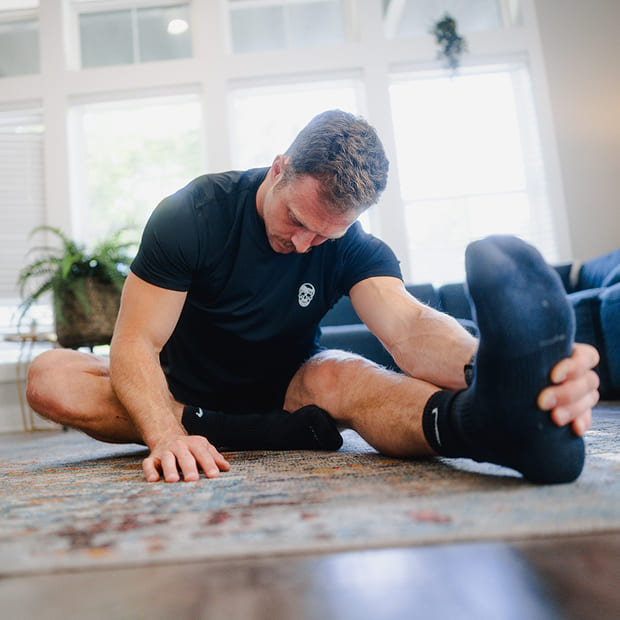
Yes, and if it's happened to you, whether it's a dull ache while you're mid-stretch or genuine soreness the next day, you're not imagining it or doing something wrong. Both are real, explainable responses, though they come from different mechanisms and call for slightly different judgment calls. Here's what's actually happening in each case, and how to tell ordinary discomfort from a sign that something's gone wrong.
A mild ache, tightness, or burning sensation while you're actually stretching is a normal part of the experience, not necessarily a problem. As a muscle lengthens toward its current end range, sensors within the muscle and tendon detect that tension and send signals to your nervous system. Exactly how these signals translate into the sensation you feel isn't fully understood, but this is generally what's behind the dull, pulling or tightness that's uncomfortable yet tolerable and eases as soon as you come out of the position.
A few sensations during a stretch point to something different than ordinary stretch discomfort, though:
Any of these during a stretch is a reason to ease out of the position immediately rather than pushing further, since they point toward a possible strain or nerve irritation rather than the ordinary discomfort of tissue being lengthened. If any of these symptoms, especially numbness, tingling, or an electric sensation, keep recurring or don't settle shortly after you stop, that's worth getting checked out by a physical therapist or doctor rather than working around it.
The soreness people feel a day or two after an intense stretching session has much in common with delayed-onset muscle soreness (DOMS), the same phenomenon you get after an unaccustomed resistance training session.
The leading explanation, though the exact details are still debated, is that tiny amounts of mechanical stress to your muscle fibers and connective tissue trigger a local inflammatory response, which makes the area more sensitive to pain over the following day or two. This is different from the outdated idea that soreness comes from a build-up of lactic acid; lactate clears from your muscles within roughly an hour of activity, well before delayed soreness typically sets in, so "flushing out lactic acid" isn't an accurate explanation for what you're feeling.
How much soreness you get after stretching depends heavily on what kind of stretching it was:
Take our FREE mobility and flexibility test to identify your strengths and areas for improvement. In minutes, get a detailed breakdown of each body zone with insights and personalized guidance to progress.
Not all post-stretch discomfort is the same, and it helps to know how to tell the two apart rather than lumping every ache into one category. Ordinary soreness and a genuine warning sign tend to differ in a few consistent ways: how quickly they show up, whether the discomfort stays spread across the muscle or sits in one specific spot, and whether it settles down with a bit of light movement or sticks around regardless of what you do.
Looking at those factors together gives you a much clearer read than just asking, "Does this hurt?"
Any of these warrant backing off and getting it assessed rather than assuming it's just normal training soreness.
None of this means you need to avoid all soreness entirely; a small amount is often just part of adapting to a new stimulus. These help keep it manageable rather than something that derails your training.
The sharpest jumps in soreness usually follow the sharpest jumps in how far, how long, or how intensely you stretch relative to what you're used to. Rather than moving straight to your deepest possible position or longest hold, add small increments over successive sessions: a few extra seconds of hold time, or a slightly deeper range, so your tissue adapts to a series of manageable steps rather than one large jump.
If you're trying PNF (a technique where you briefly contract the muscle you're stretching, then relax and move deeper into the stretch) or loaded end-range work for the first time, or significantly increasing how often you do it, treat it like a new resistance training stimulus and expect a genuine adaptation period, rather than assuming something's gone wrong if you're sore the next day.
Light movement often makes soreness feel a bit better in the moment, though the evidence on whether it actually speeds up the underlying recovery timeline is mixed. It's a low-risk thing to try alongside your normal daily activity; just don't expect it to resolve soreness on its own.
Following an intense stretching session with another maximal effort the next day, before the previous session's soreness has settled, compounds the mechanical stress rather than allowing recovery. Spacing out your most intense sessions gives tissue time to adapt between them.
A bit of soreness now and then doesn't mean stretching isn't worth it. If you need the bigger-picture reminder of why it's worth sticking with, The 7 Benefits of Daily Stretching covers what consistent stretching actually does for you over time.
Does stretching make you sore the next day?
It can, particularly with more intense or loaded stretching methods, or when you significantly increase your usual range or duration. Passive static stretching tends to cause milder soreness, if any, compared to methods involving active muscle contraction.
Is it normal to feel sore during the stretch itself, not just afterwards?
Yes, a dull, tolerable ache or pulling sensation while you're in a stretch is a normal part of the experience. It reflects your nervous system registering the tension in the tissue, and on its own isn't a sign of damage. Sharp, sudden, or radiating pain during the stretch is a different signal and worth easing off for.
Is soreness a sign that stretching is actually working?
Not necessarily. Soreness reflects that a tissue experienced more mechanical stress than it's accustomed to, which can be part of adaptation, but the absence of soreness doesn't mean a session was ineffective. Consistent, well-dosed training matters more than chasing a sore feeling every time.
Should I keep stretching through the soreness?
Light, gentle movement is usually fine and can help. Pushing back into an intense maximal stretch on already-sore tissue, particularly if the soreness is sharp or localized rather than a dull general ache, is where it's worth easing off instead.
Managing soreness well comes down to dosing your training progressively, not guessing how far is too far. The GOWOD app builds programs that increase intensity and range gradually, so you can make real progress without the guesswork.
Download GOWOD and train mobility at a pace your body can actually keep up with.
You’re only 3 steps away from unlocking your full potential.