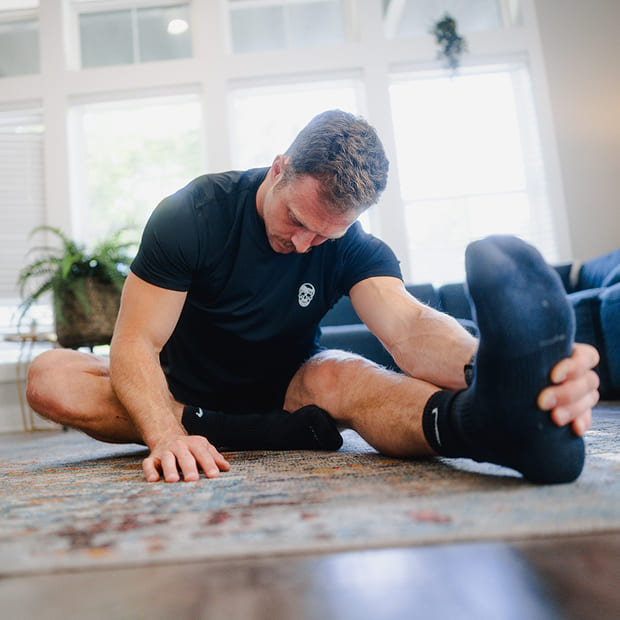
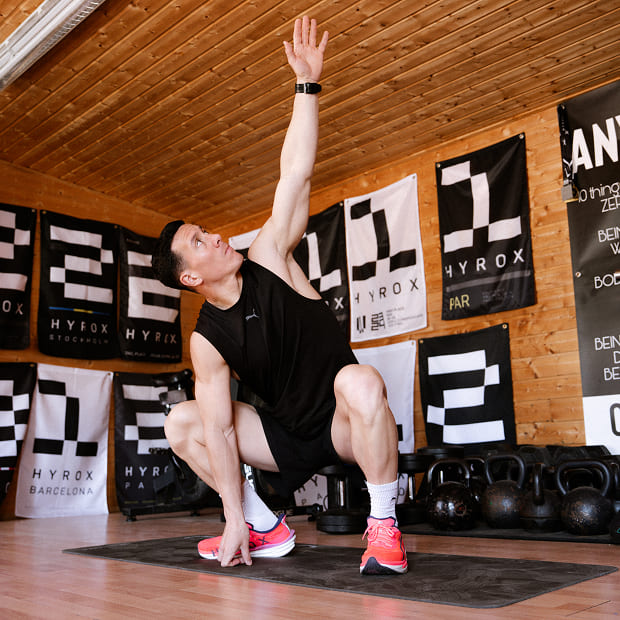
You've been stretching consistently for weeks, maybe months. At first, your range of motion opened up fast. Then, somewhere along the way, it stopped. You're still doing the work, but the needle isn't moving.
This is a common frustration in mobility training, and it isn't a motivation problem. If you've found yourself wondering why your flexibility isn't improving anymore or feel like your stretching routine has simply stopped working, you're not doing something fundamentally wrong; you've likely just outgrown the stimulus that got you this far.
Understanding why plateaus happen and what actually drives further progress is the difference between spinning your wheels and breaking through.
Most people's early flexibility gains (how far you can stretch) don't come from your muscles actually getting longer. Research suggests they mostly come from something called stretch tolerance: your nervous system becomes more tolerant of the sensation of the stretch itself, so the point of discomfort that would normally make you stop shifts further into the range. This kind of adaptation tends to happen fast, often within the first several sessions, though exactly how fast varies from person to person.
The catch is that stretch tolerance has a ceiling. Once your nervous system has adapted, doing the exact same stretch the exact same way tends to stop producing new results. Increasing the duration or frequency of your stretching can sometimes unlock further gains, but at some point, stretching alone stops being the tool that moves you forward, especially if what you actually want isn't more passive range, but usable, controlled mobility.
Before changing anything, it's worth checking whether you're actually at a plateau or just a few weeks in and expecting the fast early gains to keep repeating every month. Progress in mobility isn't always visible day to day, so measure your range of motion every few weeks using a consistent method rather than judging by feel, such as:
If your measurements stay flat for roughly a month of consistent, properly progressed training, that's a reasonable signal of a real plateau rather than normal day-to-day variation. The GOWOD app's built-in mobility tracking makes this easy to see at a glance, so you know when it's actually time to change your training rather than second-guessing yourself.
It's also worth setting realistic expectations before you assume something's wrong. The more mobile you already are, the smaller and slower each further gain tends to be, and at some point continued improvement gives way to maintenance. That's not a failure or a sign you're doing something wrong; it's what happens once you've closed most of the gap that was there to close. Strength and endurance training work the same way: early progress is fast, and eventually the goal shifts from gaining to holding onto what you've built. If that sounds like where you are, the tips below can still help you find the remaining room to grow, but it's worth knowing upfront that hitting a ceiling near your genuine potential isn't the same problem as a stimulus that's stopped working.
This is where a lot of people get stuck without realizing why. Flexibility (the passive capacity of your muscles and connective tissue to lengthen) and mobility (your ability to actively control and load a joint through that range) are not the same thing, and they don't improve through the same mechanism.
You can have a passive range of motion that your body has never learned to control. If you can only reach a position with help from gravity, a strap, or a partner, but you can't get there and hold it under your own strength, that's a flexibility gain that hasn't become a mobility gain yet. Static stretching alone rarely closes that gap because it doesn't ask your nervous system or your muscles to produce force in that new range. That takes a different stimulus entirely.
Progress in mobility training is meant to feel uncomfortable. Working near the end of your range, whether you're holding a stretch or actively loading it, means asking tissues and your nervous system to adapt to something unfamiliar, and that sensation of tension or strain is a normal part of the stimulus, not a sign something is wrong.
Pain is different. Sharp, sudden pain, or pain that lingers well after the session, is your body's way of telling you something needs attention. It doesn't always mean something is damaged, pain and tissue damage don't always line up, but it does mean you should back off the range or the load. If a movement produces this kind of pain rather than discomfort, ease off and, if it persists, get it checked out by a physical therapist or doctor.
Learning to tell the difference between productive discomfort and pain that means stop is a genuinely valuable skill to build in mobility training, and it's a big part of what separates training that progresses you from training that sets you back.
This distinction matters for plateaus specifically, because it's easy to unconsciously back off right at the point where a stretch or hold starts to feel uncomfortable, before you've actually asked your tissues and nervous system for anything new. If every session stays just inside your comfort zone, you can rack up a lot of consistent practice without much of it being a big enough stimulus to move the needle. Recognizing productive discomfort and staying with it a little longer is sometimes the real difference between more of the same and an actual plateau breaker.
Take our FREE mobility and flexibility test to identify your strengths and areas for improvement. In minutes, get a detailed breakdown of each body zone with insights and personalized guidance to progress.
These eight strategies target the actual reasons progress stalls, not just more of the training that got you here. You don't need to do all eight at once. Start with whichever one addresses your specific bottleneck, and give it a few consistent weeks before deciding it hasn't worked.
Daily practice makes a real difference. Premium GOWOD users who trained daily saw an improvement of up to 18% in their mobility score in just 60 days. Showing up consistently, even for a short session, gives your body more chances to reinforce what it's learning than doing one long session and then going quiet for days. This lines up with how the nervous system tends to learn best: through regular, spaced practice rather than one long session followed by long gaps of nothing.
Instead of only holding a passive stretch, work on actively contracting the muscles that control the joint while it's near its limit. This builds the motor control and strength needed to use the range you already have, rather than just visiting it. This is especially useful for common trouble spots like tight hamstrings, where building strength through the end range can add more than static stretching alone tends to provide, though the comparative research on this specific question is still limited, as covered in 5 Stretches to Help With Tight Hamstrings and Improve Mobility. Methods built around loaded end range work (sometimes marketed under names like PAILs and RAILs) are gaining popularity for this reason, though it's worth noting that the research base for these branded protocols is still developing. The underlying principle, training strength through a full range rather than only in the middle, is well supported.
If your goal is a deeper squat, a higher kick, or a cleaner overhead position, practice that specific movement, loaded and controlled, not just an isolated stretch that resembles it. A cleaner overhead position, for example, relies heavily on the rotational range of motion through the shoulders and thoracic spine, which we break down in Mobility Routine to Improve the Rotational Range of Motion. Motor learning is specific: the range you can access in a passive stretch doesn't automatically transfer to a dynamic, loaded movement unless you practice it there.
Consistency is easier to sustain when it doesn't require a decision every day. Pick a fixed time (first thing in the morning, before sleep, before you train) and a fixed place, and do the same routine the same way each time. Removing the daily "when will I fit this in" question is one of the simplest ways to protect consistency over the weeks and months this kind of adaptation actually takes.
Your nervous system adapts fast. The tougher, more rope-like tissues around your joints (tendons and ligaments) adapt much more slowly, since they rebuild themselves at a much slower rate than muscle does. Exactly how many weeks or months that takes varies by tissue and by person, but the pattern holds: if you're expecting month one gains to repeat every month, you're working against your own biology. Consistency over a longer horizon matters more than intensity in any single session.
The same principle that drives strength gains applies here. Gradually increase the range, the load, or the time under tension in your mobility drills over time. Repeating the exact same stretch, at the exact same intensity, indefinitely gives your body no new reason to adapt. This is easier to manage with a structured program that adjusts the stimulus for you over time, rather than guessing week to week, which is exactly the kind of progression GOWOD's mobility programs are built around.
Progression doesn't always require something new or exciting. Simple, repetitive work, like a few minutes of sustained end-range holds done every single day, can drive real change precisely because it's consistent, even when it isn't particularly interesting. The stimulus that produces adaptation and the stimulus that feels engaging aren't always the same thing, and it's worth not mistaking boredom for lack of progress.
Not every restriction is a soft tissue problem. Joint architecture (the shape of the bones themselves) sets a hard ceiling in some people that no amount of training will change, particularly at joints like the ankle or hip where bony structure often limits deep positions such as a full squat. If you suspect this applies to you, our guides on How to Improve Ankle Mobility and 7 Stretches to Help With Tight Hips and Hip Mobility can help you work out how much range is actually trainable. Old injuries, past surgeries, scar tissue, or unresolved pain can also limit range in ways that require a movement professional's assessment rather than more stretching.
If you already have excess passive range (a common finding in people with joint hypermobility) but your joints feel unstable, or you've had recurring sprains, more stretching is the wrong direction. Excess passive range without the strength to control it raises the risk of joint instability. In this case, the priority is strength and stability work at the end range, not further lengthening. If this sounds like you, it's worth discussing with a physical therapist before progressing your stretching further.
Your mobility score is useful because it puts a number on something that's otherwise hard to track, and it gives you a starting point to build from. Rather than chasing a single universal target, it helps to know where you stand relative to others who do what you do.
Here's the average mobility score by sport, based on GOWOD premium users:
Here's what that comparison can tell you:
But the number is still a baseline, not the whole picture. It's worth checking your score against how you actually feel when you move: does a movement feel easier, more controlled, less restricted than it used to? That's often a better sign of real progress than the number alone. If your score looks good but nothing feels different in how you move, that's worth a closer look at how you're performing the assessment itself, rather than assuming the number tells the whole story.
GOWOD's protocols are built around different moments in your routine, not a hierarchy of which one progresses you fastest:
All these have their place, and none of them is inherently better at driving progress than the others. What actually moves the needle is consistent mobility work, done regularly, in whichever format fits naturally into your routine. The variety exists so you can find a version of consistency that sticks, not so you have to pick the "correct" one to progress.
How long does it take to see new mobility progress after a plateau?
Once you change the stimulus (adding load, specificity, or a new drill), you'll likely notice some early progress within the first couple of weeks. Bigger, more lasting changes tend to take a few months of consistent work, though exactly how long varies from person to person.
Can you become too flexible?
Yes. Passive range of motion that exceeds what your muscles can actively control places greater demand on passive structures, such as ligaments and joint capsules, to provide stability, which can increase injury risk. More range is only useful if you can control it.
Do I need to stretch every day to keep progressing?
Consistency matters more than any single session. Daily practice tends to produce the fastest results, since it gives your nervous system the most frequent opportunities to adapt, but a few well planned sessions a week, done consistently and progressed appropriately, will beat one long session followed by days of nothing.
Ready to break through your plateau?
Breaking a mobility plateau takes structured, progressive training, not more of the same stretch. The GOWOD app builds a program around your current level and adjusts the challenge as you improve, so you're not left guessing what to change and when.
Download GOWOD and start training your mobility with a plan built to keep you progressing.
You’re only 3 steps away from unlocking your full potential.