Tight hips are one of the most common mobility complaints among active people. Long hours sitting, high-volume training, running, lifting, or simply reduced day-to-day movement can all contribute to stiffness around the hip joint. When the hips lose mobility, surrounding areas such as the lower back, knees, and pelvis often take on extra strain, which is why targeted hip mobility work can help you move more comfortably and perform better.
Try these stretches to relieve tight hips
That feeling of having completely stiff hips is highly uncomfortable. On average, we spend 12 hours a day sitting, and it leaves consequences. This impacts everyday movements, especially when we want to run, squat, cycle, or swim. The hip is a complex joint that moves through all three planes of motion.
To free yourself from stiff hips, here are the 7 best stretches to do:
Pigeon: helps release hip external rotation by stretching the glutes.
Seated piriformis stretch: the piriformis is a key muscle that will help free your hips and lower back.
V sit: releases the posterior chain and the adductors.
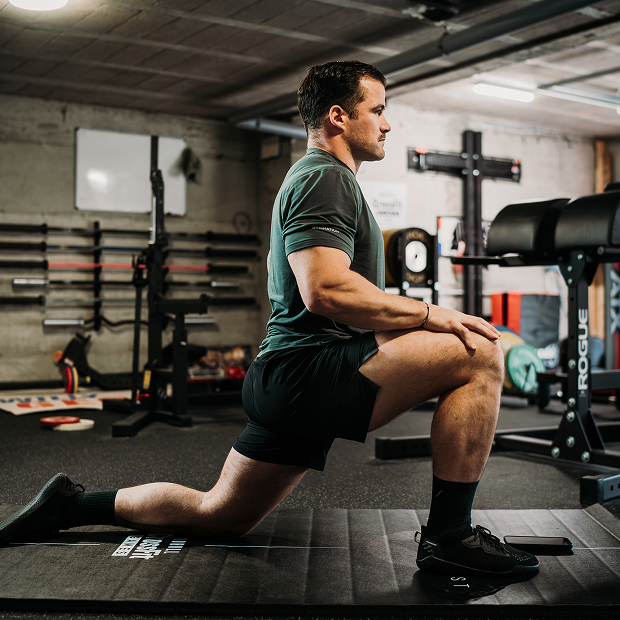
The knight to hamstring stretch: releases the hip flexors and the hamstrings.
90 to 90: active exercise that helps improve hip rotation.
Active deep squat: great exercise to release the entire hip complex.
Hip opener: active exercise that provides immediate relief.
Exercise 1/7: pigeon
Focus
Details
Timing
Repeat for 1 min
Stimulus
Stretching the glutes
Instructions
• Outer part of the knee and ankle on the floor
• Bent knee, torso leaning forward
• Back leg extended
Targeted areas
Glutes, Hips, Lumbar
Equipment required
None
Exercise 2/7: seated piriformis stretch
Focus
Details
Timing
Repeat for 1 min
Stimulus
Stretching in the middle of your butt
Instructions
• Sit with the leg crossed and foot flat
• Pull knee towards the opposite shoulder
• Keep back flat and torso facing crossed leg
Targeted areas
Glutes, Hips, Lumbar
Equipment required
None
Exercise 3/7: v sit
Focus
Details
Timing
Repeat for 1 min
Stimulus
Stretching your adductors and the backs of your thighs
Instructions
• Place your legs as wide apart as possible
• Keep your back rolled up
• Keep your chest as close to the ground as possible
Targeted areas
Adductors, Hips, Hamstrings
Equipment required
None
Exercise 4/7: the knight to hamstring stretch
Focus
Details
Timing
Repeat for 1 min
Stimulus
Tension in the hip of the back leg and a stretch in the hamstring of the front thigh
Instructions
• Phase 1: Wide lunge with your stomach pulled in and your torso straight
• Phase 2: Keep your front leg straight and lean your torso towards your front foot
• Maintain a slow and controlled rhythm while keeping your back flat
Targeted areas
Hamstrings, Hips
Equipment required
None
Exercise 5/7: 90 to 90
Focus
Details
Timing
Repeat for 1 min
Stimulus
Tension in the hips
Instructions
• Start with your hips and knees bent to 90º
• Keep your torso as straight as possible, and your abs tight
• Perform slow and controlled movements
Targeted areas
Hips, Glutes
Equipment required
None
Exercise 6/7: active deep squat
Focus
Details
Timing
Repeat for 1 min
Stimulus
Tension in the hips and thighs
Instructions
• In a squat position, upright torso, engaged abdominals
• Tip of the knee touches the ground, using the foot as a pivot
• Dynamic alternating movements between the right and left knee
Targeted areas
Hips, Glutes
Equipment required
None
Exercise 7/7: hip opener
Focus
Details
Timing
Repeat for 1 min
Stimulus
Tension in the hip
Instructions
• In a wide lunge, front knee turned outward
• Opposite hand on the ground
• Active, slow and controlled movement
Targeted areas
Hips, Adductors, lumbar
Equipment required
None
Understanding hip tightness
Hip tightness is extremely common, particularly for people who train regularly or spend significant time seated. The hip joint relies on a balance of mobility and stability, and when one area becomes overworked, other regions often become stiff to compensate. Tight hip flexors, underactive glutes, reduced rotation, and limited posterior chain length can all influence how your hips move.
Below are some of the most frequent contributors to hip stiffness:
Long periods of sitting lead to shortened hip flexors.
High training volume without targeted mobility.
Limited hip rotation affects squat and hinge depth.
Poor glute activation is causing compensatory tightness.
The hip is a ball-and-socket joint that allows movement in multiple directions. Key structures involved include:
Hip flexors. Crucial for lifting the knee and stabilising the pelvis.
Glutes. Major power producers for running, squatting, and lifting.
Deep rotators, including the piriformis. Important stabilisers that control rotation.
Adductors. Support lateral stability and help with force transfer.
Hamstrings. Influence hip extension and pelvic position.
When any of these tissues become tight, movement efficiency decreases, often leading to stiffness in the lower back or knees. Improving mobility across the hip complex helps distribute load evenly and supports better performance across all training styles.
How hip mobility supports performance
Improved hip mobility is commonly used to:
Support deeper, stronger squats.
Improve stride length and running efficiency.
Reduce compensatory stress on the lower back.
Improve posture and pelvic control.
Help maintain technique during long training sessions.
Because so many athletic movements start with the hips, restoring mobility often creates noticeable improvements in power, comfort, and movement quality.
Common reasons your hips feel tight
Different patterns of stiffness can point toward different contributors:
Symptom
Common contributing factors
Tightness at the front of the hips
Sitting, shortened hip flexors, overuse in running
Pinching during squats
Limited hip rotation, tight glutes, deep stabiliser tension
Stiffness after training
Fatigue, tissue overload, insufficient cooldown
Lower back discomfort
Hips not rotating fully, poor glute activation
Understanding your tension pattern can make your mobility sessions more effective and specific.
FAQs
What causes tight hips in active people? Tight hips are commonly caused by long periods of sitting, high-volume training, limited rotation, or muscular imbalances between the hip flexors and glutes.
How often should I stretch my hips? Most people benefit from 5 to 10 minutes of hip mobility work several times per week. Consistency is more important than duration.
Can hip tightness affect my lower back? Yes. When the hips do not rotate or flex well, the lower back often compensates, leading to stiffness or discomfort.
Is it normal for hip stretches to feel intense? Hip stretches often feel strong because the tissues are thick and powerful. The sensation should feel like controlled tension, not sharp pain.
Which stretch should I start with if my hips feel very stiff? Many people start with the seated piriformis stretch or pigeon to release rotation before moving into deeper positions.
UNLOCK YOUR BODY
Start your journey to better mobility
You’re only 3 steps away from unlocking your full potential.
Download the GOWOD App
Take your assessment
Improve your mobility one stretch at a time with GOWOD Premium