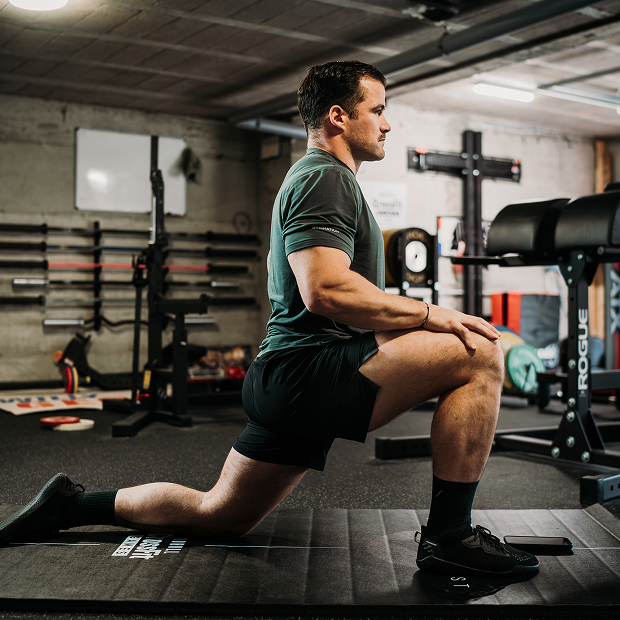
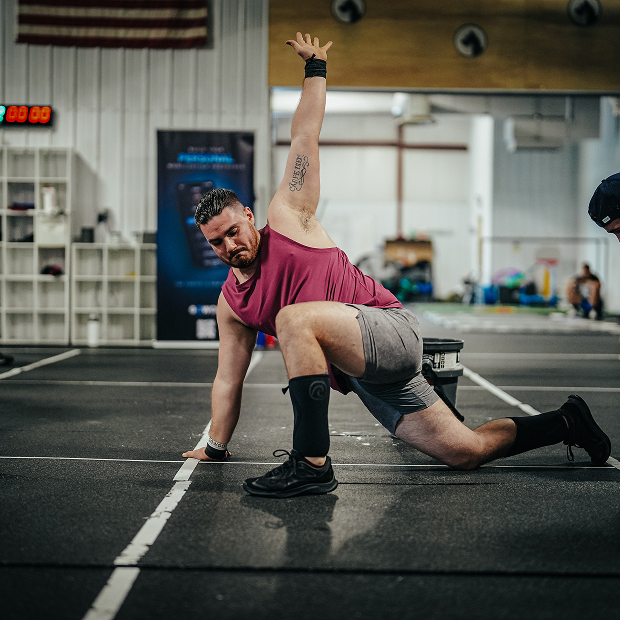
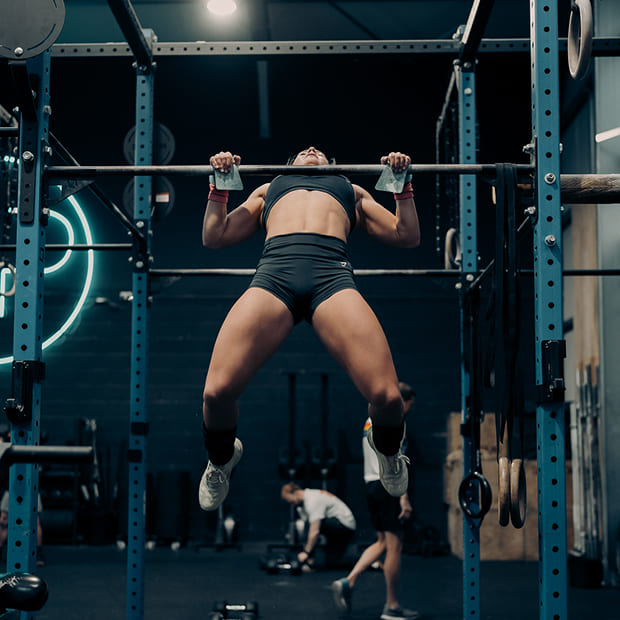
A heavy back squat makes specific demands on your hips that passive flexibility alone cannot meet. You need active hip flexion depth while your lower back stays neutral under load. You need hip external rotation to keep your knees tracking correctly as you descend. And you need your glutes and posterior chain to be coordinated and ready to drive out of the bottom position with control. When any of those capacities is limited, your position breaks down under load, and the lift costs more than it should.
Jayson Hopper, 2025 CrossFit Games champion and holder of a 500 lb back squat, built this routine around those exact demands. Each exercise targets a specific physical requirement of the back squat so your body is ready to squat heavy and move well from the first rep.
This routine is built around what the back squat actually demands from your body: active hip depth with a neutral spine, hip external rotation for correct knee tracking, and glute and posterior chain coordination to drive powerfully out of the bottom position. Each exercise targets one or more of those requirements directly.
Together, these movements address the specific physical limitations that compromise back squat position and mechanics. By building both range and active control through the hips and posterior chain, they support a stronger bottom position and more consistent technique across working sets.
Take our FREE mobility and flexibility test to identify your strengths and areas for improvement. In minutes, get a detailed breakdown of each body zone with insights and personalized guidance to progress.
The back squat is the foundational strength movement in CrossFit. At maximal load, it requires active hip depth, precise hip rotational control, and posterior chain coordination working together simultaneously. The bar position on the back tolerates more forward lean than a front squat, but it does not eliminate the mobility demands of the lift. Restrictions in the hip complex present directly as positional faults that reduce force transfer and increase the mechanical load on the lower back.
These demands interact throughout every rep. A restriction in hip external rotation that causes knee valgus also reduces the mechanical advantage of the glutes, increasing lower back demand. Preparing all of these capacities together is more effective than addressing any single area in isolation.
What does the back squat require from your mobility?
The back squat requires three primary physical capacities: active hip depth with a neutral spine to reach and hold the bottom position under load; hip external rotation to maintain proper knee tracking throughout the movement; and glute and posterior chain coordination to drive powerfully out of the bottom position. A restriction in any one of these produces a compensatory fault that reduces force transfer and increases mechanical load on the structures compensating for it.
Why does hip external rotation matter so much for the back squat?
Hip external rotation allows the knees to track in line with the feet throughout the full range of the squat. When external rotation is restricted, the knees cave inward under load, reducing the mechanical advantage of the glutes and placing the knee joint under stress it is not designed to manage repeatedly under heavy load. Athletes often compensate by excessively turning their feet outward, which alters squat mechanics rather than addressing the underlying restriction.
Should I do mobility work before or after heavy squatting?
Both, but with different purposes. Pre-session mobility prepares the hips and posterior chain for the specific demands of heavy back squat work, so your body can access the required positions from the first rep rather than working into them over early sets at lower percentages. Post-session mobility supports tissue homeostasis and restores range in structures that have been working under significant compressive load. Specifically for heavy squatting, pre-session preparation directly affects positional quality and the rate at which compensatory patterns develop as load increases.
How long does it take to improve active hip depth for the back squat?
Passive flexibility changes can begin within a few weeks of consistent practice, through mechanisms such as viscoelastic relaxation and adaptations in stretch tolerance. However, the quality that transfers into a heavy back squat is active hip depth under load, which requires the nervous system to produce and control movement at those ranges while the bar is pressing down. This adaptation takes longer to develop. For most athletes, meaningful improvements in squat depth and positional control under load are noticeable within 4 to 8 weeks of consistent, targeted work with continued development over months.
Can this routine help with other squatting movements in CrossFit?
Yes. The active hip depth, hip external rotation, and posterior chain coordination developed in this routine are foundational to all squatting patterns in CrossFit. Front squats, overhead squats, squat cleans, and wall balls all place overlapping demands on the same systems. The hip mobility and glute activation work developed here also supports more efficient running mechanics and lunge patterns. Improvements in these capacities support stronger, more consistent positions across every movement that requires hip depth and posterior chain control.
Download GOWOD and start with your personalized mobility assessment.
You’re only 3 steps away from unlocking your full potential.