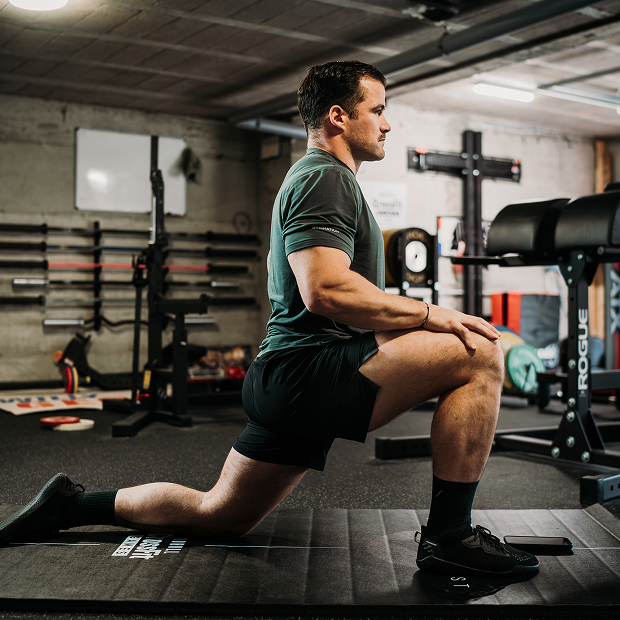
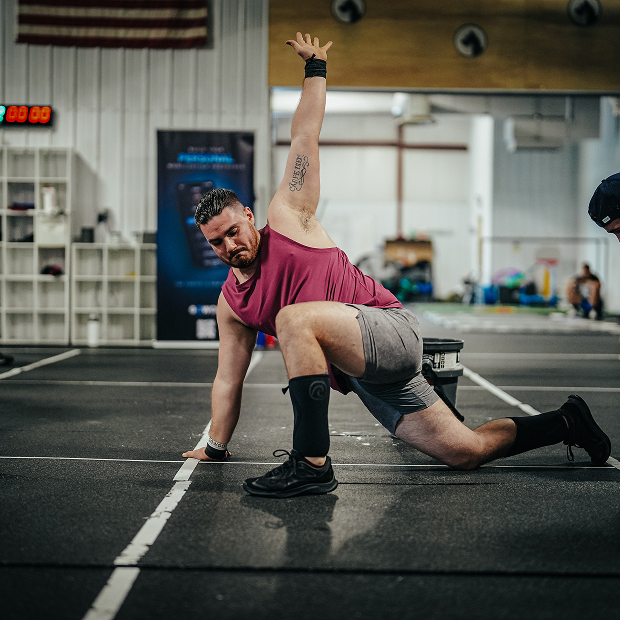
"I'm more flexible than I used to be" is easy to say and much harder to prove. Flexibility is one of the most commonly discussed fitness qualities, yet most people have never measured it in a consistent way. Knowing what you're actually measuring and how helps you track real progress instead of relying on how a stretch happened to feel on a given day.
Before choosing a measurement method, it's important to understand what you're trying to assess.
Flexibility refers to the passive range of motion available at a joint when movement is produced by an external force. It reflects both the mechanical properties of the surrounding tissues and your nervous system's tolerance to stretch. This passive range is influenced by several factors, including muscle and tendon properties, joint capsule characteristics, individual anatomy, and the nervous system's tolerance to stretching.
Mobility builds on flexibility by combining available range of motion with the strength, motor control, and coordination needed to actively use that range.
Many standard flexibility assessments aim to estimate passive range of motion, although some commonly used field tests combine several joints and can also be influenced by body proportions and movement strategy. While passive range of motion provides useful information about flexibility, the result is also influenced by factors such as your joint structure, your tolerance to stretching, and the way the test is performed. If a flexibility assessment doesn't specify whether it's measuring passive or active range of motion, it's worth finding out. The difference between the two can be substantial, even at the same joint.
Each of these methods measures a different aspect of joint movement, whether passive flexibility, active range of motion, generalized joint laxity, or movement during functional tasks. Understanding these differences helps you interpret the results correctly.
A goniometer is a hinged, protractor-like tool placed along a joint to measure the angle between two body segments at the end of a passive range of motion. It is widely considered the clinical standard for measuring joint range of motion when standardized procedures and experienced examiners are used. The trade-off is that it takes some practice to position consistently, and small differences in anatomical landmark placement between sessions can affect the result.
This is the most familiar flexibility test for most people because it's simple and requires little more than a box or ruler. It's worth understanding what it actually measures: a combination of hamstring flexibility, lower back flexibility, and the influence of arm and torso length, which varies between individuals. The result is also affected by movement strategy and body proportions. Because it combines several factors into a single score, it shouldn't be interpreted as a direct measure of hamstring flexibility alone. Two people with similar hamstring flexibility can achieve noticeably different results.
A digital inclinometer, or a smartphone app using the phone's built-in gyroscope, measures joint angle in a similar way to a manual goniometer. These tools have made single-joint range-of-motion measurement far more accessible outside a clinical setting, though accuracy depends on consistent phone placement and calibration; treating the result as a useful estimate rather than a lab-grade measurement is the safer approach. Some smartphone apps have demonstrated good validity in research settings, whereas others have not been formally evaluated. Consistent positioning remains essential for reliable measurements.
This is a screening tool for generalized joint hypermobility rather than a flexibility measure in the usual sense. It assesses passive range across nine specific movements (including the thumb, little finger, elbow, knee, and forward trunk flexion) to flag individuals with overall connective tissue laxity above average. A high Beighton score indicates generalized joint hypermobility, which may be associated with increased connective tissue laxity in some individuals, although the underlying mechanisms vary. In individuals with symptomatic generalized joint hypermobility, repeated aggressive end-range stretching without concurrent strength and motor control training may contribute to episodes of instability. It's a useful check before starting an intensive flexibility program, not just a curiosity.
Recording a movement and analyzing joint angles frame by frame, either manually or with motion-tracking software, allows measurement of active range of motion during a real movement pattern, rather than an isolated passive test. This is closer to measuring mobility than flexibility in the strict sense, since it captures what a joint can do under your own control rather than what it can be passively moved into.
If you'd rather skip the equipment and get a structured read on where you stand, the GOWOD app includes a built-in mobility test. Rather than measuring passive flexibility, it assesses your active range of motion through sport-specific movement patterns (regions such as the shoulders, thorax, hips, and ankles) and flags which areas are optimal versus limiting for the activity you've selected. It takes just a few minutes to complete, generates an overall mobility score, highlights areas that may benefit from additional work, and builds a personalized routine based on your mobility profile and chosen sport.
Take our FREE mobility and flexibility test to identify your strengths and areas for improvement. In minutes, get a detailed breakdown of each body zone with insights and personalized guidance to progress.
A single flexibility measurement tells you very little on its own. What makes any of these methods useful is measuring the same thing, the same way, consistently enough to actually track change over time.
Range of motion naturally varies throughout the day due to factors such as muscle temperature, recent activity, and neuromuscular state, meaning a measurement taken first thing in the morning may not be directly comparable to one taken after an evening workout. Picking a consistent time for retesting reduces this source of noise.
A warm-up often increases passive range of motion through a combination of mechanical and neuromuscular effects, making post-warm-up measurements difficult to compare with measurements taken from a cold start. Neither approach is more correct than the other for tracking your own progress, but switching between them between sessions makes the numbers hard to compare.
For goniometry or app-based measurement, small differences in where you place the tool or phone can shift the reading by several degrees. Photographing your setup the first time, or using consistent bony landmarks, helps keep repeat measurements comparable.
Meaningful changes in flexibility generally require several weeks of consistent training, although the rate of progress varies depending on the individual, the joint being trained, and the program used. Testing every few weeks, rather than every session, gives you a more accurate picture of real progress rather than noise.
If your goal is usable mobility rather than passive flexibility, track both an active range of motion (what you can reach under your own muscular control) and a passive one (what you can be moved into). Improvements in passive flexibility do not automatically translate into better active mobility, because actively controlling a range of motion also depends on strength and motor control. If that gap sounds like your situation, What Is Mobility Training breaks down how targeted mobility work closes it, since passive stretching alone is often not sufficient when the primary limitation is strength or motor control.
What's a normal amount of flexibility?
There's wide individual variation in passive range of motion across joints, influenced by factors such as genetics, training history, anatomy, and connective tissue characteristics. Population reference ranges can be useful in clinical contexts, but for tracking your own progress, your personal baseline is often more informative than a generic average. Reference values should still be interpreted in relation to the joint, testing method, and individual context.
Is the sit-and-reach test a good way to track my hamstring flexibility?
It provides a rough, easy-to-repeat measure, but because it combines hamstring extensibility with spinal mobility, body proportions, and movement strategy, it is not a precise way to isolate hamstring flexibility. A standardized straight-leg raise or joint-specific goniometric assessment can provide a more targeted estimate, although these tests are still influenced by pelvic position, stretch tolerance, and testing technique.
Do I need special equipment to track my own flexibility?
Not necessarily. A smartphone angle app, a doorframe as a reference point, or simple photos taken from a consistent position can help track visible changes over time, as long as your setup and method remain consistent between sessions.
Measuring flexibility is only useful if you know what to do with the number. The GOWOD Mobility Test takes just a few minutes, gives you a clear mobility score, and uses your results and sport profile to build a routine around the areas most relevant to your current mobility needs.
Download GOWOD and take the Mobility Test to get a clearer picture of your current mobility profile.
You’re only 3 steps away from unlocking your full potential.