August 17, 2026

Alan Cao's mobility routine for wall balls

Wall balls place simultaneous demands on your body that most training does not specifically prepare. You need active hip flexion and extension through full range of motion under cyclical load, thoracic extension capacity to support the overhead position, and shoulder flexion stability at end range to control the ball at the top of every rep. When any of those capacities is limited, your mechanics break down under fatigue, and each rep costs more than it should.

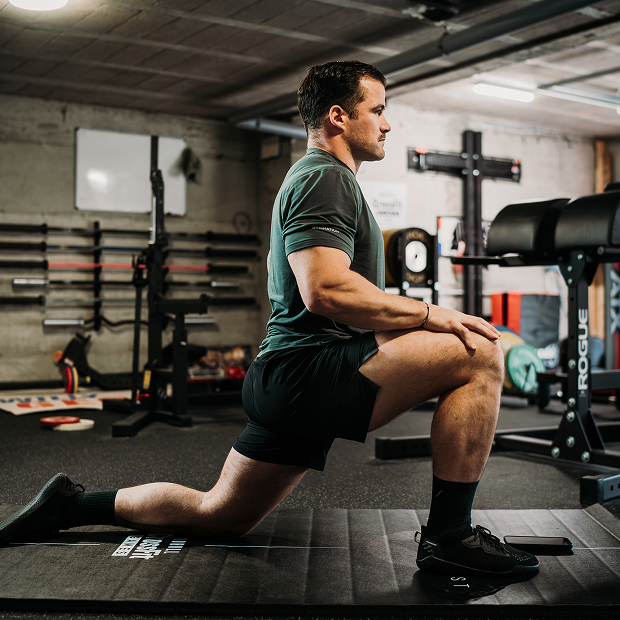
Alan Cao, one of the most prolific HYROX athletes in the world, with 47 races across three seasons and multiple wins, including in London, Madrid, and Barcelona, built this routine around those exact demands. Each exercise targets a specific physical requirement of wall balls, so you arrive at the station with the range and control needed to move through it efficiently from the first rep to the last.

Wall ball activation mobility routine

This routine is built around what wall balls actually demand from your body: active hip mobility through full range of motion under cyclical load, thoracic extension capacity for the overhead position, and shoulder flexion stability at end range. Each exercise targets one or more of those requirements directly.

  • Active pec stretch to address pectoral and anterior shoulder restriction that limits overhead range and thoracic extension capacity.

  • The hip axle to develop active hip rotational range and the neuromuscular control needed to cycle efficiently through the squat pattern under load.

  • Active frog to restore hip flexion and external rotation range in the positions that the bottom of the wall ball squat demands.

  • Back roll in overhead position to develop thoracic extension and overhead mobility simultaneously, targeting both demands of the wall ball in a single movement.

  • Specific lower back roll to manage tissue tension in the lumbar region that accumulates under repeated cyclical loading and affects squat depth and position.

  • 90 to 90 to build hip internal and external rotation range and active control across the full rotational demand of the squat cycle.

  • Air front rack to rehearse the full wall ball movement pattern under controlled conditions, reinforcing squat depth, thoracic position, and overhead stability before adding load.

Together, these movements address the specific physical limitations that reduce wall ball efficiency. By building both range and active control through the hips, thoracic spine, and shoulders, they support cleaner mechanics and more consistent output across the full station.

Exercise 1/7: active pec stretch

Focus Details
Timing Repeat for 1 min.
Stimulus Stretch in the pectoral muscle.
Instructions • Elbow and hand in contact with the support, at nose height.
• Foot on the same side placed one step forward.
• Repeated movements bringing the torso forward.
Targeted areas Pec
Shoulders
Equipment required None

Exercise 2/7: the hip axle

Focus Details
Timing Repeat for 1 min.
Stimulus Tension in the hip, stretching the adductors.
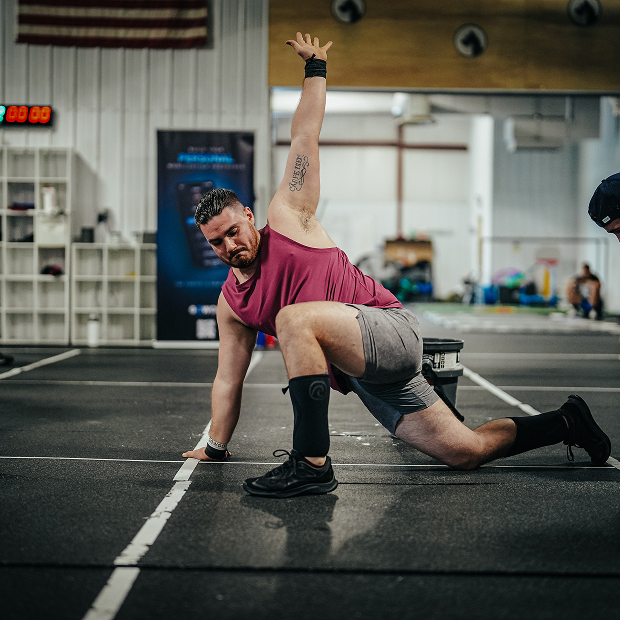
Instructions • Kneeling, leaning forward with hands flat on the floor.
• One leg extended to the side, heel on the ground.
• Rotations of the extended leg in line with the hip axis.
Targeted areas Adductors
Hamstrings
Hips
Equipment required None

Exercise 3/7: active frog

Focus Details
Timing Repeat for 1 min.
Stimulus Stretching in the hips.
Instructions • Knees on the ground, spread as wide as possible.
• Shins parallel, elbows and forearms on the floor.
• Hips brought close to the heels. Controlled movements.
Targeted areas Adductors
Hips
Equipment required None

Exercise 4/7: back roll in overhead position

Focus Details
Timing Repeat for 1 min.
Stimulus The pressure should allow you to remain relaxed.
Instructions • Place roller in the middle of your back.
• Extend arms above your head.
• Maintain a rhythmic rate of 50 movements per minute.
Targeted areas Traps
Equipment required Foam roller

Exercise 5/7: specific lower back roll

Focus Details
Timing Repeat for 1 min.
Stimulus The pressure should allow you to remain relaxed.
Instructions • Place roller on your lumbar region.
• Keep feet flat on the ground, with torso turned to one side.
• Maintain a rhythmic rate of 50 movements per minute.
Targeted areas Lumbar
Equipment required Foam roller

Exercise 6/7: 90 to 90

Focus Details
Timing Repeat for 1 min.
Stimulus Tension in the hips.
Instructions • Start with your hips and knees bent to 90 degrees.
• Keep your torso as straight as possible, and your abs tight.
• Perform slow and controlled movements.
Targeted areas Hips
Glutes
Equipment required None

Exercise 7/7: air front rack

Focus Details
Timing Repeat for 1 min.
Stimulus Tension in the hips, thighs and glutes.
Instructions • Feet hip-width apart, elbows bent, thumbs on shoulders.
• Hips pushed back and down. Core engaged, elbows pointing forward.
• Hips descending below knee level.
Targeted areas Hamstrings
Lumbar
Hips
Quad
Equipment required None
Know your mobility like never before

Is your mobility limiting your performance?

Take our FREE mobility and flexibility test to identify your strengths and areas for improvement. In minutes, get a detailed breakdown of each body zone with insights and personalized guidance to progress.

  • Less than 15 minutes
  • Tests your entire body
  • View detailed analytics
  • Get a personalized mobility plan

What wall balls actually demand from your body

Wall balls are a cyclical, compound movement. Every rep requires a full squat under load followed by an explosive triple extension and an overhead throw, repeated continuously under fatigue. The combination of deep-squat mechanics, thoracic extension demands, and overhead stability requirements makes it one of the most physically demanding stations in HYROX. A restriction in any of the relevant systems does not just reduce power output. It creates compensatory patterns that compound with every rep.

Physical demand Why it limits wall balls How it presents
Active hip flexion range The squat portion of each rep requires deep hip flexion under load with a neutral spine. Restricted hip flexion forces compensatory lumbar flexion or a reduced squat depth, both of which reduce power output and increase lower back load. Shortened squat depth, forward trunk lean increasing through the station, lower back fatigue accumulating across reps.
Thoracic extension capacity The overhead throw requires the thoracic spine to extend sufficiently to support a vertical arm position at the top of each rep. Restricted thoracic extension forces the lumbar spine to compensate and reduces the efficiency of force transfer from the squat into the throw. Lumbar hyperextension during the throw, ball released short of target height, shoulder fatigue accumulating early in the station.
Shoulder flexion stability at end range The ball must be controlled overhead at full shoulder flexion at the top of each rep. Without adequate end-range stability, the shoulder complex fatigues rapidly, and positional control degrades under cyclical loading. Loss of overhead position as the station progresses, inconsistent ball height, anterior shoulder discomfort under fatigue.
Hip rotational control The squat cycle involves internal and external rotation through the hip on each rep. Restricted hip rotation reduces squat efficiency and increases compensatory loading at the knee and lower back. Knee valgus in the squat, lateral trunk shift, foot position changes as fatigue accumulates.

In a race format, these demands repeat across a full set of wall balls at high intensity, sandwiched between running kilometers. Restrictions that are manageable in isolation become significant performance limiters when accumulated fatigue is factored in. Preparing these capacities specifically before the station is what allows mechanics to hold up from the first rep to the last.

FAQs

What does the wall ball station require from your mobility?
Wall balls require three primary physical capacities: active hip flexion range to reach full squat depth under load without lumbar compensation, thoracic extension capacity to support an efficient overhead position at the top of each rep, and shoulder flexion stability at end range to control the ball consistently across the full station. A restriction in any one of these reduces mechanical efficiency and increases the load on the structures compensating for it, which compounds significantly under fatigue.

Why does hip mobility matter so much for wall balls?
The squat portion of each wall ball rep requires deep hip flexion under load with a neutral spine. When hip mobility is restricted, the body compensates either by reducing squat depth, thereby reducing power output, or by flexing the lumbar spine, thereby increasing lower back load. In a station that requires repeated, cyclical reps at high intensity, compensation costs time and increases the risk of cumulative strain. Hip mobility is also directly relevant to the running between stations, making it one of the highest-value areas to address for overall HYROX performance.

Should I do mobility work before or after a HYROX race or training session?
Both, but with different goals. Pre-session mobility prepares the hips, thoracic spine, and shoulders for the specific demands of the session or race, so your body can access the required positions from the first rep rather than working into them under fatigue. Post-session mobility supports recovery by restoring range of motion in tissues that have been loaded repeatedly and helping the body return to its baseline state before the next training input. Using the same routine for both reduces the effectiveness of each.

How long does it take to improve active hip flexion range for wall balls?
Passive flexibility changes can begin within a few weeks of consistent practice, through mechanisms such as viscoelastic relaxation and adaptations in stretch tolerance. However, the quality that translates into wall ball performance is active hip flexion range under load, which requires the nervous system to produce and control movement within those ranges while the hip works against resistance. This adaptation takes longer to develop. For most athletes, meaningful improvements in squat depth and positional control under load are noticeable within 4 to 8 weeks of consistent, targeted work with continued development over months.

Can this routine help with other HYROX stations beyond wall balls?
Yes. The active hip mobility, thoracic extension capacity, and shoulder stability developed in this routine are relevant across multiple HYROX stations. The sled push and pull, lunges, and burpee broad jumps all place overlapping demands on hip range and trunk control. The overhead carry and ski erg require similar thoracic and shoulder capacity. Improvements in these areas do not transfer automatically to specific station technique, but they remove the physical limitations that reduce efficiency and increase the rate at which movement quality improves with practice.

Download GOWOD and start with your personalized mobility assessment.

UNLOCK YOUR BODY

Start your journey to better mobility

You’re only 3 steps away from unlocking your full potential.

  • Download the GOWOD App
  • Take your assessment
  • Improve your mobility one stretch at a time with GOWOD Premium
Three smart phones depicting GOWOD app interfaces. From Left to right: a guided workout of the Samson Stretch with a built-in timer, a personalized dashboard with mobility scores and statistics, and the opening screen of the GOWOD app.

Resources

Start today
Get the GOWOD app
Download