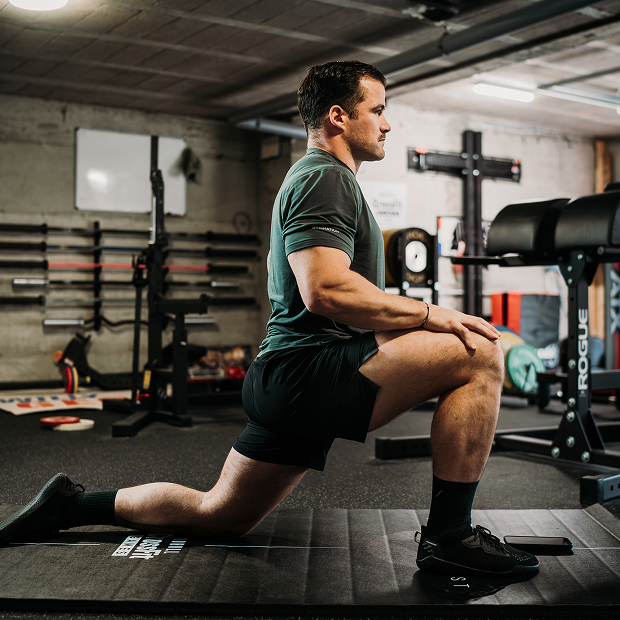
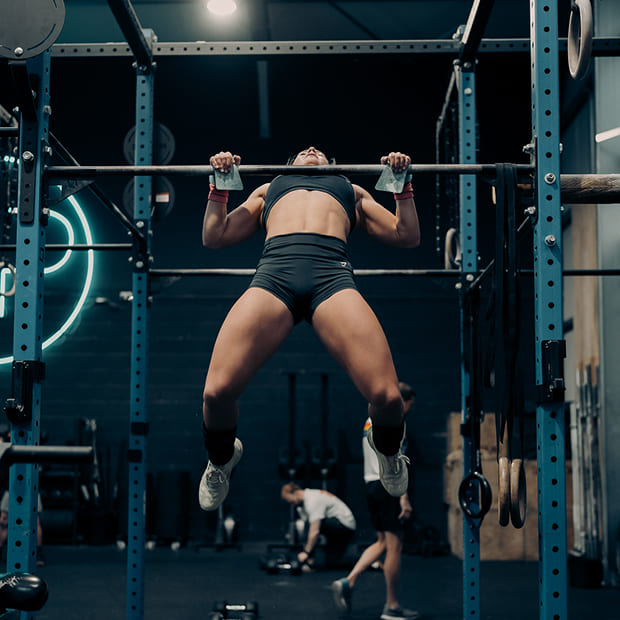
Wall balls place simultaneous demands on your body that most training does not specifically prepare. You need active hip flexion and extension through full range of motion under cyclical load, thoracic extension capacity to support the overhead position, and shoulder flexion stability at end range to control the ball at the top of every rep. When any of those capacities is limited, your mechanics break down under fatigue, and each rep costs more than it should.
Alan Cao, one of the most prolific HYROX athletes in the world, with 47 races across three seasons and multiple wins, including in London, Madrid, and Barcelona, built this routine around those exact demands. Each exercise targets a specific physical requirement of wall balls, so you arrive at the station with the range and control needed to move through it efficiently from the first rep to the last.
This routine is built around what wall balls actually demand from your body: active hip mobility through full range of motion under cyclical load, thoracic extension capacity for the overhead position, and shoulder flexion stability at end range. Each exercise targets one or more of those requirements directly.
Together, these movements address the specific physical limitations that reduce wall ball efficiency. By building both range and active control through the hips, thoracic spine, and shoulders, they support cleaner mechanics and more consistent output across the full station.
Take our FREE mobility and flexibility test to identify your strengths and areas for improvement. In minutes, get a detailed breakdown of each body zone with insights and personalized guidance to progress.
Wall balls are a cyclical, compound movement. Every rep requires a full squat under load followed by an explosive triple extension and an overhead throw, repeated continuously under fatigue. The combination of deep-squat mechanics, thoracic extension demands, and overhead stability requirements makes it one of the most physically demanding stations in HYROX. A restriction in any of the relevant systems does not just reduce power output. It creates compensatory patterns that compound with every rep.
In a race format, these demands repeat across a full set of wall balls at high intensity, sandwiched between running kilometers. Restrictions that are manageable in isolation become significant performance limiters when accumulated fatigue is factored in. Preparing these capacities specifically before the station is what allows mechanics to hold up from the first rep to the last.
What does the wall ball station require from your mobility?
Wall balls require three primary physical capacities: active hip flexion range to reach full squat depth under load without lumbar compensation, thoracic extension capacity to support an efficient overhead position at the top of each rep, and shoulder flexion stability at end range to control the ball consistently across the full station. A restriction in any one of these reduces mechanical efficiency and increases the load on the structures compensating for it, which compounds significantly under fatigue.
Why does hip mobility matter so much for wall balls?
The squat portion of each wall ball rep requires deep hip flexion under load with a neutral spine. When hip mobility is restricted, the body compensates either by reducing squat depth, thereby reducing power output, or by flexing the lumbar spine, thereby increasing lower back load. In a station that requires repeated, cyclical reps at high intensity, compensation costs time and increases the risk of cumulative strain. Hip mobility is also directly relevant to the running between stations, making it one of the highest-value areas to address for overall HYROX performance.
Should I do mobility work before or after a HYROX race or training session?
Both, but with different goals. Pre-session mobility prepares the hips, thoracic spine, and shoulders for the specific demands of the session or race, so your body can access the required positions from the first rep rather than working into them under fatigue. Post-session mobility supports recovery by restoring range of motion in tissues that have been loaded repeatedly and helping the body return to its baseline state before the next training input. Using the same routine for both reduces the effectiveness of each.
How long does it take to improve active hip flexion range for wall balls?
Passive flexibility changes can begin within a few weeks of consistent practice, through mechanisms such as viscoelastic relaxation and adaptations in stretch tolerance. However, the quality that translates into wall ball performance is active hip flexion range under load, which requires the nervous system to produce and control movement within those ranges while the hip works against resistance. This adaptation takes longer to develop. For most athletes, meaningful improvements in squat depth and positional control under load are noticeable within 4 to 8 weeks of consistent, targeted work with continued development over months.
Can this routine help with other HYROX stations beyond wall balls?
Yes. The active hip mobility, thoracic extension capacity, and shoulder stability developed in this routine are relevant across multiple HYROX stations. The sled push and pull, lunges, and burpee broad jumps all place overlapping demands on hip range and trunk control. The overhead carry and ski erg require similar thoracic and shoulder capacity. Improvements in these areas do not transfer automatically to specific station technique, but they remove the physical limitations that reduce efficiency and increase the rate at which movement quality improves with practice.
Download GOWOD and start with your personalized mobility assessment.
You’re only 3 steps away from unlocking your full potential.