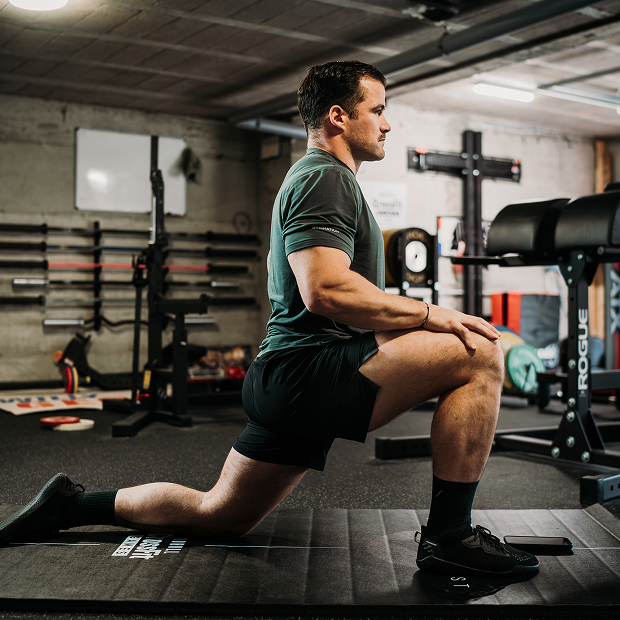
Mobility work and daily stretching are often reduced to a flexibility habit. That framing misses why mobility practice matters for people who train regularly.
For active bodies, stretching and mobility training are less about increasing range and more about how the body manages load, absorbs stress, and repeats movement day after day.
Training places consistent demands on joints, muscles, and connective tissue. When certain areas stop moving well, other parts are forced to compensate, even if strength and conditioning are in place.
This is where the benefits of stretching and daily mobility practice show up. Regular, low-dose exposure to controlled movement helps the body maintain usable positions, distribute force more evenly, and recover more reliably between sessions. Over time, this influences performance output, injury risk, readiness to train, and long-term movement quality.
For the best outcome, mobility work should be personalized to your weaknesses and physical activity instead of following mobility exercises based on how you 'feel' each day. Apps such as GOWOD offer this functionality by testing your body and offering personalized stretching/mobility routines to follow.
Performance depends on how well force moves through the body. Strength and power are only useful if joints and tissues can accept and transfer that force efficiently.
When movement is restricted, force does not travel cleanly. Instead, it gets absorbed or redirected through compensations. This often shows up as slower movement, reduced power, or inconsistent performance despite adequate strength.
Mobility work helps you access the positions needed for optimal force transfer. With tissues that can adapt to load and joints available through the right ranges, the energy you produce is more likely to be used efficiently, rather than dissipated elsewhere through unnecessary tension and poor postural compensation.
Injury risk depends less on flexibility and more on how well tissues tolerate repeated load or impact. Problems often develop when certain areas of the body compensate for a lack of mobility elsewhere: they end up overloaded, unable to share the effort effectively. Mobility, in fact, is exactly this: the capacity to generate force through the right range of motion.
Regular exposure to controlled ranges helps tissues adapt to stress more evenly. Daily mobility work supports this by encouraging load to be shared across joints and muscle groups rather than concentrated in one area.
Stretching and massage alone are not enough to prevent injury. What makes the difference is the combination: mobility work targeted at identified weak points, efficient technical execution made possible by sufficient range of motion, and consistent load progression. Together, these help the body absorb training better and limit the compensations that can become points of weakness over time.
Training stress does not exist in isolation. Sleep, work demands, sitting time, and mental fatigue all influence how the body responds to sport-specific demands.
As overall stress increases, the nervous system often responds by increasing muscle tone. Movement can feel restricted or fragile, even without pain. This is a sign that the system is becoming less adaptable.
Stretching, massage, and daily mobility work provide input that helps keep tissues responsive rather than reactive. Regular exposure to controlled movement supports readiness by maintaining movement confidence before stress accumulates too far.
Range of motion is only useful if it can be accessed and controlled during movement. Large ranges that cannot be used under load offer little benefit, while limited access to key positions can quietly affect technique and efficiency.
Mobility work and certain short, targeted stretches help maintain access to the ranges required for training, such as squatting depth, overhead positions, hip rotation, and spinal movement. Without consistent exposure, these ranges tend to narrow over time, even in relatively active people.
The aim is not extreme flexibility. It is preserving a useful, controlled range to move well, train comfortably, and avoid unnecessary compensations.
Feeling tight does not always mean a muscle is short. In many cases, this sensation reflects a protective response from the nervous system, influenced by fatigue, movement habits, and recovery levels.
High training volume combined with limited recovery often increases this feeling of stiffness, particularly at the start of sessions or during warm-ups.
Gentle daily stretching and mobility work act directly on this: by regularly exposing the body to controlled ranges, they increase the nervous system's tolerance for movement. Over time, the feeling of tension decreases and movement becomes smoother, without ever needing to force range.
Recovery is not just about resting between sessions. It is about restoring movement quality so the body is prepared to train again.
Stretching and massage support recovery by encouraging local circulation, maintaining tissue tolerance, and allowing joints to move through their available range of motion with less resistance. This type of work can also promote a relaxed state that supports recovery, helping the nervous system shift toward rest.
Gentle, regular stretching is usually more effective than occasional intense sessions. Consistency supports recovery without adding extra stress to the system.
Movement quality often declines gradually, without obvious warning signs. Restrictions tend to appear quietly until certain positions become harder to access day to day.
Stretching and daily mobility work help maintain joint range of motion and movement variability. By keeping tissues adaptable, the body retains more ways to manage load as demands change over time.
Longevity is not about becoming more flexible. It depends on consistency, maintaining genuinely usable ranges of motion, and the ability to produce force through those ranges, the ones that serve you day to day as well as in sport. This is what allows you to stay active and limit injury risk over the long term.
Daily stretching, and mobility work in particular, is most effective when personalized, as GOWOD's app offers, and practiced consistently, ideally every day. It is not a fix for poor training decisions, and it does not replace technical skill development or adequate recovery through sleep and nutrition.
That said, stretching and mobility work remain a clearly underrated part of an athlete's routine. They support training by helping the body tolerate load better, move more efficiently, and arrive at each session in better condition. Over the long term, their impact can be considerable.
When treated as a consistency tool rather than a quick fix, mobility becomes a practical lever for preserving movement quality and supporting long-term training sustainability.
Find the right stretching and mobility routine for your sport and your weak points by downloading the GOWOD app and taking your mobility test today.
You’re only 3 steps away from unlocking your full potential.