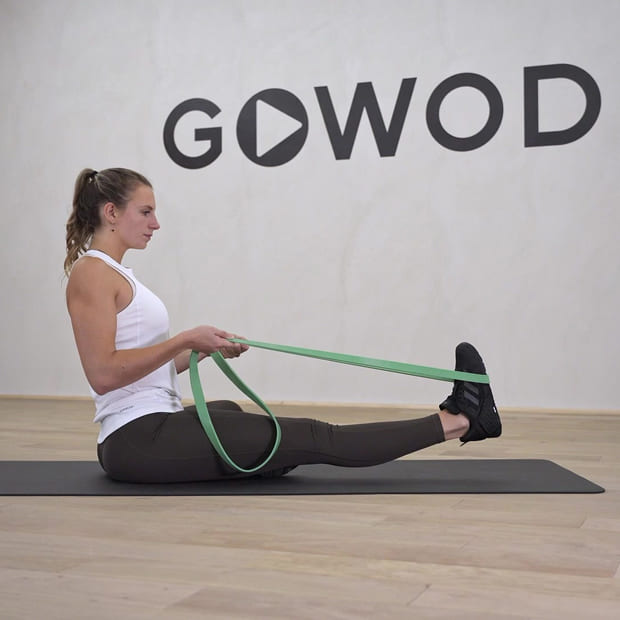
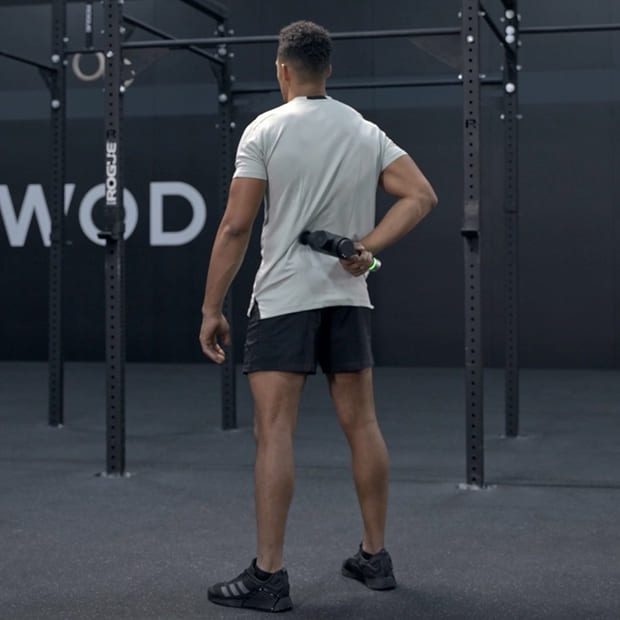
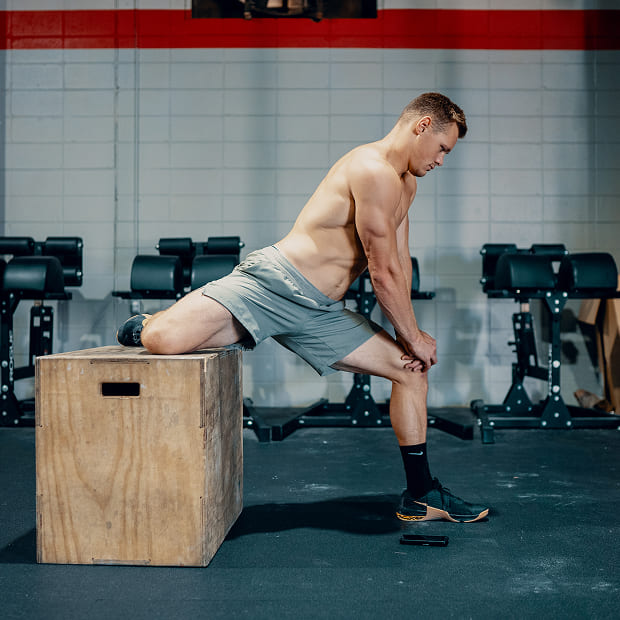
The beginner ankle mobility routine is about getting your knee to travel forward over your toes with the heel down. This routine is about keeping that position when it counts: with load on the ankle, with a band pulling against you, and at the bottom of a deep squat.
All five exercises are active, so your own muscles move the ankle through its range rather than holding a passive stretch. The routine takes about 7 minutes at 1 minute per exercise, working both sides on the banded and kettlebell exercises, and it’s designed to go before training. You’ll need a wall, a resistance band with a low anchor point such as a rack or post, and a kettlebell.
If you haven’t built a base yet, start with our beginner ankle mobility routine.
Each exercise asks the ankle to work at the end of its range, then takes that range into a squat. Work through them in order:
Take our FREE mobility and flexibility test to identify your strengths and areas for improvement. In minutes, get a detailed breakdown of each body zone with insights and personalized guidance to progress.
To sit deep into a squat with your heels down, your shins need to travel forward over your feet. That forward movement is dorsiflexion, and in a deep squat it’s often taken close to the end of the ankle’s range. When the ankle runs out of range before the hips reach depth, the body may compensate: the heels may lift, the torso may tip further forward, or the knees may drift inward to find extra room.
Squat depth isn’t only about the ankles. Hip shape, stance width and how your hips move all play a part, which is why comfortable squat depth varies so much between people. But if your heels are the first thing to give, the ankles are a good place to start. For a broader look at the joint, read our guide on how to improve ankle mobility.
This routine moves from the calf, to the ankle under load, to the full squat:
| Exercise | What it trains | Where you’ll feel it |
|---|---|---|
| Wall-assisted dynamic calf stretch | Dorsiflexion with the knee close to straight, emphasizing the upper calf. | Calves. |
| Banded ankle mobilization | Dorsiflexion with the knee bent, with a band adding a pull at the ankle. | Front of the ankle and lower calf. |
| KB ankle mobilization | Dorsiflexion with the knee bent, under the added load of a kettlebell. | Ankle and lower calf. |
| Active deep squat | Control at the bottom of a squat, with the feet as the pivot point. | Hips, glutes and thighs. |
| Bottom squat rotation | Holding squat depth while the upper body rotates. | Hips, upper back, chest and arms. |
The order matters. The first three exercises work the ankle on its own. The last two put that range to use in the squat position, where the ankle, knee and hip all have to work together.
The biggest step up from the beginner routine is that two exercises add external resistance to the ankle.
In the banded ankle mobilization, the band is anchored low and placed above the front ankle, so it pulls backward as you rock the knee forward. Many people find this changes where they feel the movement, more at the front of the ankle and less in the calf.
In the KB ankle mobilization, the kettlebell sits on the front knee and adds weight over the ankle as the knee moves forward and around. This asks the ankle to control its range under load, much as it does at the bottom of a loaded squat.
Both exercises are done one side at a time, so they’re also a good way to notice whether one ankle moves differently from the other.
No band or kettlebell on hand? The wall-assisted dynamic calf stretch, active deep squat and bottom squat rotation still make a solid warm-up for the ankles and squat position.
This routine works best as the ankle part of your warm-up before a lower-body session, a run or anything with deep squatting. These guidelines will help you get the most from it:
For more on what to do before a session, read our article on whether you should stretch before every workout.
This routine assumes you’re already comfortable with the beginner ankle exercises. You’re likely ready for it when:
As with the beginner routine, consistency matters more than intensity. Range and control build with regular practice over several weeks, and using this routine as part of your warm-up before most lower-body sessions is a simple way to keep it regular.
Our approach starts with an individual assessment. The mobility test looks at your ankles alongside other key areas, so your routines focus on what is actually limiting your movement rather than following a generic routine.
What equipment do I need for this routine?
A wall for the wall-assisted dynamic calf stretch, a resistance band with a low anchor point such as a rack or post for the banded ankle mobilization, and a kettlebell for the KB ankle mobilization. The active deep squat and bottom squat rotation use bodyweight only.
Should I do this routine before or after training?
It’s designed for before training, especially ahead of squats, lunges or running. After a session, or on rest days, the beginner ankle routine is a better fit.
What if my heels lift in a deep squat?
Work within the depth you can control with your heels down, and build from there. In the app, the active deep squat and bottom squat rotation each have an easy mode, a simpler version of the exercise you can switch to.
How is this different from the beginner ankle routine?
The beginner routine builds the basic range with stretching, self-massage and simple active exercises. This routine adds resistance with a band and a kettlebell, and takes that range into the deep squat position.
How often should I do it?
Before most lower-body sessions is a good rhythm. Short, regular sessions are easier to keep up than occasional long ones.
A generic routine is a good place to start. A personalized approach goes further by addressing what is actually limiting your ankles.
GOWOD analyzes your mobility, identifies your restrictions, and builds routines around your body and your training. A structured plan makes the difference, whether you want to squat deeper with your heels down, land and change direction more comfortably, or warm up with more purpose.
With GOWOD, you get:
Download GOWOD now and start improving the way you move.
You’re only 3 steps away from unlocking your full potential.