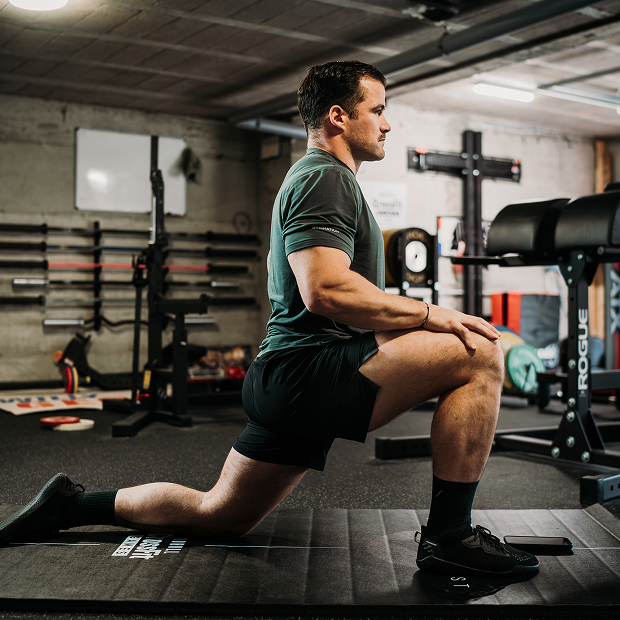
Mobility training is a form of physical training focused on improving joint movement within the available range of motion, emphasising active control, strength, and coordination. Rather than simply increasing flexibility, it develops how the nervous system, muscles, and connective tissues interact to produce efficient, repeatable movement under real-world demands.
When people ask what mobility is, they are often trying to understand why they feel restricted, stiff, or unstable in certain positions, even if they stretch regularly or train consistently. In many cases, the limitation is not muscle tightness alone, but reduced control at specific joint angles or limited tolerance to load at the edges of range. Mobility training addresses this by improving joint function and movement capacity, rather than focusing solely on muscle length.
From a biomechanics perspective, mobility refers to the ability to actively control a joint through its usable range of motion. This includes how smoothly joint surfaces articulate, how well surrounding muscles coordinate to stabilize the movement, and how effectively force is transferred across the kinetic chain during sport or everyday activities.
Mobility training offers benefits that extend beyond simply reducing stiffness. By improving joint control, positional awareness, and load tolerance, it can support both performance and long-term durability across a wide range of sports and training styles.
Rather than targeting symptoms in isolation, effective mobility work improves how the body distributes force across multiple joints. This systems-level effect is particularly relevant for athletes who train frequently, repeat similar movement patterns, or place high mechanical demands on specific joints.
Some of the key benefits include:
From a physiological standpoint, mobility training can improve tissue tolerance by progressively exposing joints, muscles, and connective tissues to controlled end-range positions. Over time, this can enhance adaptation to training stress and help reduce the cumulative overload that often contributes to overuse issues.
Mobility training does not aim to push joints into extreme or passive positions. Instead, it focuses on expanding and reinforcing the range of motion an athlete can actively control. This is where meaningful gains in performance capacity and resilience tend to occur, because the body is better prepared to handle force at the positions it actually uses in sport.
Mobility training is not limited to elite athletes. It can support movement quality across a wide range of activity levels. The way mobility is applied, however, should reflect the demands placed on the body.
Mobility training should reflect how often and how intensely someone trains. An individual performing occasional resistance sessions will have different mobility demands than someone training at high intensity multiple times per week.
Structured systems such as those in the GOWOD app help align mobility work with training frequency, sport demands, and individual movement profiles, making mobility more strategic and less generic.
Mobility training is not a single method or type of exercise. It combines different movement strategies to improve joint control, coordination, and efficient movement in response to training demands.
Rather than focusing on one joint in isolation, effective mobility training considers how joints work together. The ankle influences the knee, the hip influences the lumbar spine, and the thoracic spine influences shoulder mechanics. Improving mobility, therefore, means improving how movement is distributed across the kinetic chain.
Common components of mobility training include:
These components work together to create usable mobility. The goal is not simply to increase the range of motion, but to strengthen and control that range so it transfers to real movement.
For example, improving hip mobility may involve controlled rotations, split-squat variations, or deep-squat holds with active engagement. Improving shoulder mobility may include overhead control drills, scapular stability work, and thoracic spine movements that support efficient arm mechanics.
The defining feature of mobility training is intent. Exercises are selected to improve movement quality and control simultaneously, ensuring that increased range is supported by coordination and strength.
GOWOD approaches mobility as a structured, personalized system rather than a collection of random exercises.
Instead of assigning generic routines, mobility work is guided by an initial assessment. The mobility test evaluates how key joints move within sport-relevant positions, producing a personalized mobility profile. This score highlights where restrictions or asymmetries exist and helps determine which areas should receive priority.
Based on this profile, mobility sessions are tailored to the individual. Rather than stretching everything equally, routines target the joints and ranges most likely to affect movement efficiency and training consistency.
The GOWOD library of mobility exercises contains over 300 guided videos covering major joints and common sport demands. Each exercise includes clear demonstrations and structured guidance, helping athletes understand how movements fit into a broader mobility strategy.
This combination of assessment, personalization, and structured programming allows mobility training to become progressive and relevant, rather than repetitive or guess-based.
Take our FREE mobility and flexibility test to identify your strengths and areas for improvement. In minutes, get a detailed breakdown of each body zone with insights and personalized guidance to progress.
Mobility training and stretching are related, but they are not the same.
Stretching primarily targets muscle length and passive range of motion. It often involves static or assisted positions designed to reduce stiffness or increase tolerance to stretch. While this may allow a joint to move further, it does not automatically improve how well that range can be controlled.
Mobility training focuses on active control. It develops strength, coordination, and stability throughout a joint’s usable range of motion, particularly at the edges of that range. Rather than simply increasing motion, mobility training aims to make that motion accessible under load and during dynamic movement.
In simple terms:
Stretching can be part of a mobility strategy, but mobility training is what integrates range, control, and performance.
One of the biggest challenges with mobility training is knowing where to start. Without assessment, many people default to stretching areas that already move well, while overlooking the joints and positions that are actually limiting performance. Over time, this can reinforce compensations rather than resolve them.
The GOWOD mobility test is designed to evaluate how your body moves through key joints and positions commonly stressed during training and sport. Instead of measuring flexibility in isolation, the test assesses how joints function within coordinated movement patterns, which is far more relevant to real-world performance and load demands.
Through a series of controlled movement assessments, the test helps identify:
These insights matter because movement restrictions rarely exist in isolation. A limitation at the ankle, hip, shoulder, or thoracic spine often shifts mechanical demand elsewhere, increasing stress on joints that are not designed to repeatedly absorb it. Over time, this can contribute to inefficient mechanics, reduced force transfer, or recurring discomfort.
Based on the assessment results, GOWOD uses this data to guide mobility routines that align with your current movement capacity. Rather than applying generic stretches or fixed routines, mobility work is selected to target the joints and ranges that need the most attention, while respecting overall training volume, intensity, and recovery demands.
By establishing a clear baseline, mobility training becomes a structured and progressive process rather than a random collection of exercises. This enables mobility work to support training consistency, mechanical efficiency, and long-term durability, rather than simply reacting to symptoms as they arise.
Mobility is not just about short-term relief or feeling loose before a workout. Over time, how well your joints move and how effectively you control that movement directly affect training consistency, performance, and long-term movement resilience.
When mobility is limited, the body rarely stops moving. Instead, it adapts. Joints with greater available motion are required to compensate for those with restrictions, often absorbing more load than they are structurally prepared to handle. During overextended training blocks, this redistribution of stress can accumulate in tissues that may not be conditioned for that level of repeated demand, resulting in recurring tightness, reduced force production, or persistent discomfort.
Mobility training addresses this at the source. Expanding controlled movement options and reinforcing stability at key joint angles improve the transfer of force along the kinetic chain. When joints contribute more evenly, movement becomes more efficient, energy leaks are reduced, and mechanical stress is better distributed.
Applied consistently, mobility training supports:
Understanding what mobility training is is the first step. Applying it strategically is what creates meaningful change.
If you want to take a more informed approach, begin by assessing how your body moves and identifying any restrictions or asymmetries. From there, targeted mobility work becomes a structured performance tool rather than a reactive solution.
Download GOWOD today and take the mobility test to understand your current mobility level and start building mobility work around what your body actually needs.
You’re only 3 steps away from unlocking your full potential.