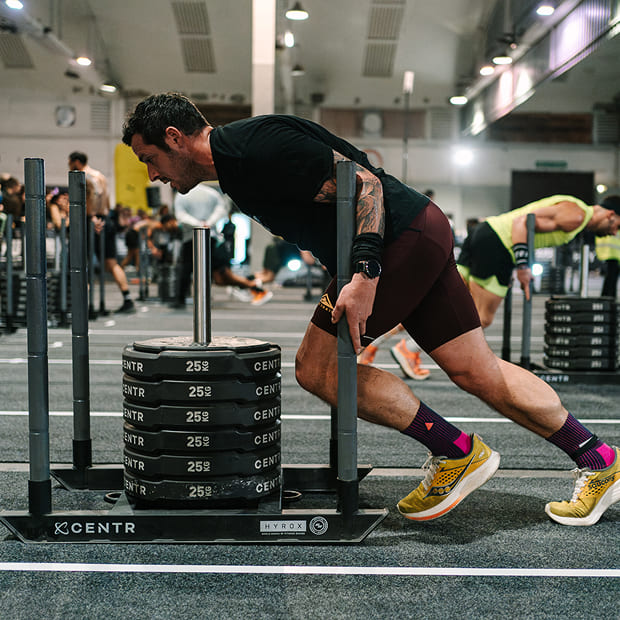
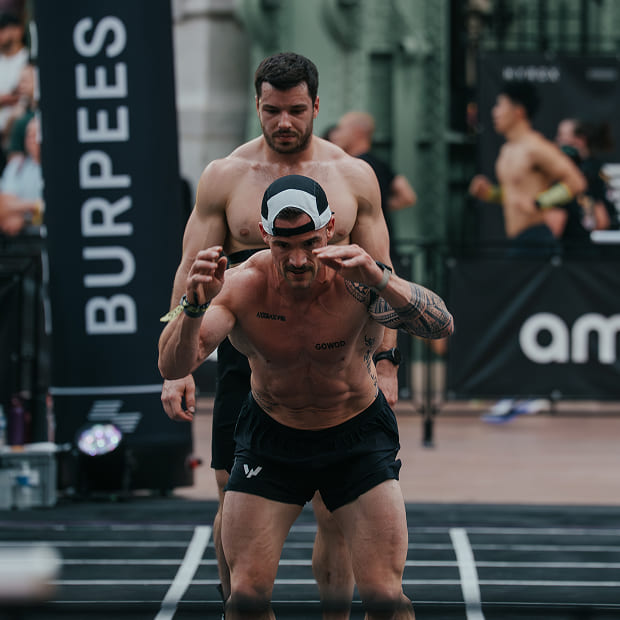
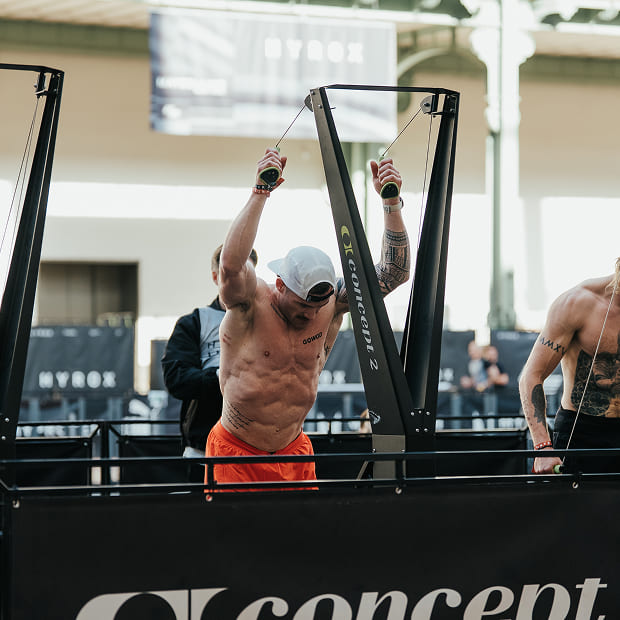
The HYROX® Farmers Carry uses two kettlebells carried simultaneously for a total distance of 200 metres. The weight varies by division. Each weight has a corresponding kettlebell colour, which is how athletes identify the correct one at the station.
It is the athlete's responsibility to select the correct weight for their division. Using the wrong weight and completing all or part of the station means the entire station must be repeated using the correct weight. Failure to do so results in disqualification.
The Farmers Carry looks straightforward: pick up two kettlebells and walk 200 metres. What makes it hard at Station 6, after 6km of running and five prior stations, is that it tests two things simultaneously: grip endurance and postural strength under load.
Experienced HYROX coaches and sports scientists describe it less as a grip test and more as a postural endurance challenge: how long can you maintain an upright, efficient position before posture starts to break down under load?
When athletes start to struggle at this station, the sequence is almost always the same. The shoulders round forward. The upper back collapses. The chest drops. The torso begins to sway. Once posture goes, efficiency goes with it: the bells feel heavier, grip fatigue accelerates, and pace drops. The hands are often not the limiting factor. The upper back is.
This reframe changes how you should prepare. Grip work matters, but building upper back strength, scapular stability, and the ability to maintain tall posture while moving under load matters equally.
Depending on the venue, 200 metres may involve multiple laps of a shorter course. Athletes are responsible for familiarizing themselves with the athlete map at their specific event and completing the required number of laps. The distance does not change, but the layout does.
The station begins and ends with the removal and return of the kettlebells from a marked box next to the start and finish line. Carrying the kettlebells across the finish line and returning them to the correct box with handles in the upright position completes the station.
Walk fast. This is not a slow grind. The Farmers Carry rewards pace. Think march rather than stroll. Quick, short steps keep momentum and reduce the total time your grip is under load. Slow, shuffling steps keep you under load for longer than necessary.
Stay tall. Shoulders back and down, chest up, core braced throughout. The weight will pull your shoulders forward and round your upper back if you allow it. A rounded carry position increases lower back load, slows your walking speed, and makes the bells feel heavier than they are. When you feel posture starting to slip, the cue is simple: brace hard and pull your shoulder blades back together. It takes a second and costs nothing, but it stops the spiral.
Let the arms hang. Keep them long and straight, hanging naturally at the sides. Do not shrug the bells up or bend the elbows. Both positions add unnecessary tension through the shoulders and forearms and accelerate grip failure. Your hands are hooks. Your job is to hold on, not to assist.
Eyes forward, not down. Athletes who look at the floor tend to round their backs. Looking at where you are going keeps the head position neutral and supports an upright posture.
Step rate over stride length. When fatigue builds, the instinct is to slow down and take longer, more deliberate steps to reduce effort. Counter-intuitively, picking up your step rate when struggling is more efficient because you cover ground faster and the time under load shortens.
Grip is the variable that determines whether this station is fast or slow. By Station 6, the hands have already been tested by the Ski Erg and the Sled Pull. The Farmers Carry arrives at the point of maximum accumulated grip fatigue.
Go unbroken if you can. The time cost of setting the bells down is higher than most athletes expect. A deliberate set-down, a shake-out, and a re-grip take a minimum of 10 to 15 seconds. Picking them back up recruits the same fatigued grip structures you were resting. Every set-down also makes the next decision harder: do I put them down again?
If your grip is genuinely failing and you cannot hold on, set the bells down deliberately and briefly. Three deep breaths, then pick them back up. Commit to that limit before you set them down. Do not drift into a long unplanned rest.
The Farmers Carry is Station 6. What comes before it matters. The Row Erg is Station 5, and arriving from a well-paced row means more grip endurance in reserve than arriving from an all-out sprint. After the Farmers Carry comes Run 7 and then Sandbag Lunges, a station that does not test grip directly. The Farmers Carry is the last station in the race that directly loads grip. That means you can afford to spend it here.
Optimize your performance, accelerate your recovery and prepare your body with personalized mobility training.
In Doubles, partners share the 200 metres using a You Go I Go format. The resting partner walks behind the working partner at all times and must not obstruct other athletes. When switching, the kettlebells are placed on the ground and the next partner picks them up from that position. They must not be passed forward.
In Relay, the Relay Member assigned to Station 6 completes the full 200 metres alone.
For a full breakdown of all eight stations and how the race is structured, the HYROX stations guide and the complete race guide cover both in detail.
The Farmers Carry demands the ability to maintain an upright, tall posture under bilateral load across 200 metres. Two distinct issues tend to drive progressive rounding under load.
Restricted thoracic extension limits the ability to maintain spinal extension through the mid and upper back. Weakness or fatigue in the scapular retractors (particularly the mid and lower trapezius and rhomboids) allows the shoulders to protract and roll forward under sustained load; shortened pectorals can contribute to this same pattern. When the upper back rounds, the centre of mass of the load moves further in front of the lumbar spine, increasing the moment arm and requiring greater spinal extensor force to maintain position. The lower back works harder, pace drops, and the bells feel more demanding than they did at the start.
Before the race, dynamic thoracic mobilisation and low-load upper back activation (such as scapular retractions or band pull-aparts) increase neuromuscular readiness in the specific muscles that maintain posture under load, helping them engage more effectively from the first metres of the carry. The pre-race activation guide covers the full race day warm-up sequence.
After the race, the forearms, upper back, and lower back carry the most accumulated load from this station. The post-race recovery guide covers what to do in the hours after finishing. Lower back mobility work is particularly relevant for recovery given the sustained postural demand across 200 metres of loaded walking.
Mobility exercises targeting thoracic extension and posterior chain endurance build the postural foundation that holds up under race fatigue. GOWOD builds personalized routines based on your individual movement profile, so the work you do in training targets what your body actually needs rather than a generic programme.
You’re only 3 steps away from unlocking your full potential.