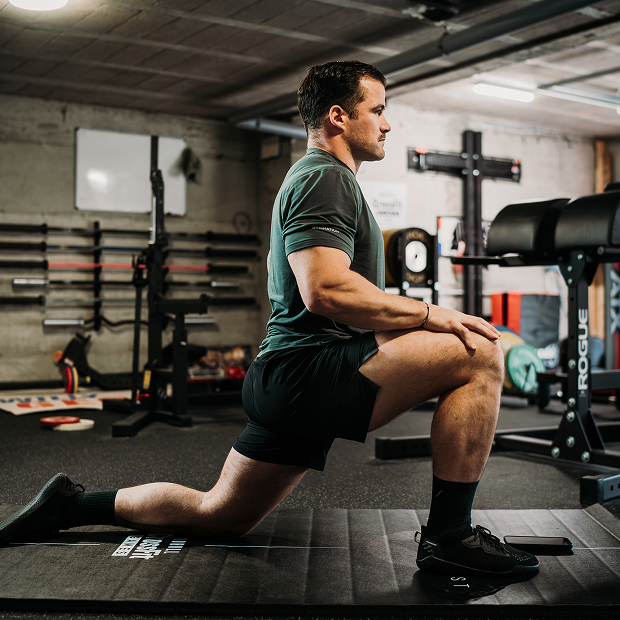
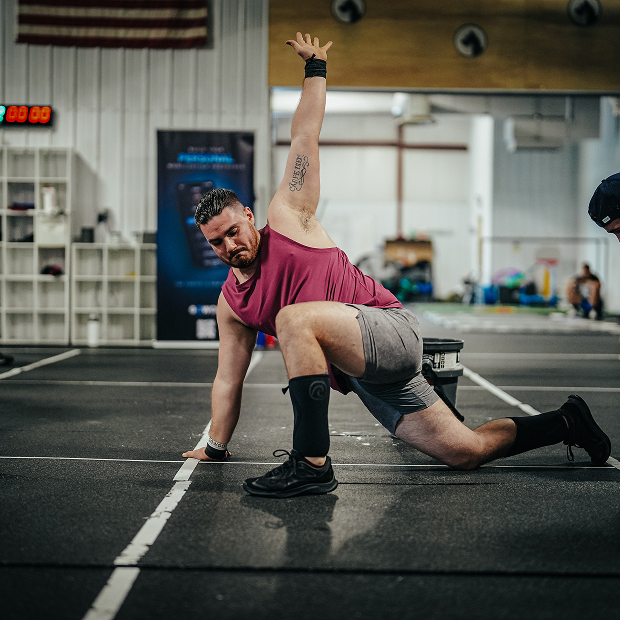
Holding a powerful aero position for hours places specific demands on your body that standard training does not directly address. Your hip flexors must tolerate sustained flexion without pulling your pelvis into anterior tilt, which compromises power output and lower back position. Your hamstrings and glutes need sufficient extensibility to support the posterior pelvic positioning the aero position requires. And your lumbar spine needs enough mobility to maintain a flat back under prolonged forward lean. When any of those capacities is limited, the position degrades progressively as the ride goes on, costing power and loading the structures that were never designed to compensate for it.
Sam Laidlow, Ironman World Championship winner at Kona 2024 and three-time Kona podium finisher, built this routine around those exact demands. Each exercise targets a specific physical requirement of the aero position, so you can hold it efficiently from the first kilometer to the last.
This routine is built around what the cycling aero position actually demands from your body: hip flexor extensibility to tolerate sustained flexion without anterior pelvic tilt, posterior chain capacity to support an efficient lumbar position under load, and lumbopelvic control to maintain a flat back across hours of forward lean. Each exercise targets one or more of those requirements directly.
Together, these movements address the specific physical limitations that cause the aero position to break down during a long ride. By building both range and active control through the hips, posterior chain, and lumbar spine, they support a more powerful and sustainable position from start to finish.
Take our FREE mobility and flexibility test to identify your strengths and areas for improvement. In minutes, get a detailed breakdown of each body zone with insights and personalized guidance to progress.
The aero position is one of the most physically demanding sustained postures in endurance sport. It compresses the hip flexors into sustained flexion, continuously loads the posterior chain, and requires the lumbar spine to maintain a flat position during prolonged forward lean. Over the course of a full Ironman bike leg, these demands compound significantly. Restrictions that are barely noticeable in the first hour become meaningful mechanical breakdowns by the third.
In triathlon, these limitations do not just affect comfort. They affect power output, running economy off the bike, and the physical state you arrive in for the run. A hip flexor that has been progressively shortening under hours of aero load does not suddenly lengthen when you rack your bike. The work you do before the ride determines how well your body holds up across the whole race.
What does the cycling aero position require from your mobility?
The aero position requires three primary physical capacities: hip flexor extensibility to tolerate sustained flexion without anterior pelvic tilt, posterior chain capacity to support an efficient lumbar position under load, and active lumbopelvic control to maintain a flat back across hours of forward lean. A restriction in any one of these produces compensatory loading that compounds progressively over the course of a long ride.
Why do hip flexors matter so much for the aero position?
The hip flexors are held in sustained compression throughout the bike leg. When they lack the extensibility to tolerate that load without compensation, the pelvis progressively tilts anteriorly as the ride goes on. This increases lumbar loading, reduces the mechanical efficiency of the pedal stroke, and compromises the power output the athlete can sustain. The progressive nature of this breakdown is what makes it particularly costly in long course triathlon, where the bike leg alone can last four to five hours at race pace.
Should I do mobility work before or after a long bike session?
Both, with different purposes. Pre-session mobility prepares the hip flexors, posterior chain, and lumbopelvic system for the sustained demands of the aero position, reducing the rate at which compensatory patterns develop as the ride progresses. Post-session mobility helps restore range of motion in tissues that have been held in sustained shortened positions and supports the recovery of normal joint variability before the next training load. Using the same routine for both purposes reduces the effectiveness of both.
How long does it take to improve hip flexor extensibility for the aero position?
Passive flexibility changes can begin to occur within a few weeks of consistent practice through mechanisms such as viscoelastic relaxation and adaptations in stretch tolerance. However, the quality that matters for the aero position is not passive hip flexor length but active extensibility under sustained load, which means the nervous system tolerates and controls that range while the hip is working against resistance. This adaptation takes longer to develop and requires consistent, targeted exposure over weeks to months. For most athletes, meaningful improvements in sustained position quality are noticeable within 4 to 8 weeks of regular targeted work.
Can this routine help with running mechanics off the bike in triathlon?
Yes. The hip flexor extensibility, posterior chain capacity, and lumbopelvic control developed in this routine are directly relevant to running mechanics, particularly the ability to achieve full hip extension during the running stride. Hip flexors that have been progressively shortening under hours of aero load do not automatically reset when the run begins. Athletes who arrive at the run with better hip flexor extensibility and lumbopelvic control are able to produce more efficient running mechanics from the first kilometer, which is one of the key determinants of run performance in long course triathlon.
Download GOWOD and start with your personalized mobility assessment.
You’re only 3 steps away from unlocking your full potential.