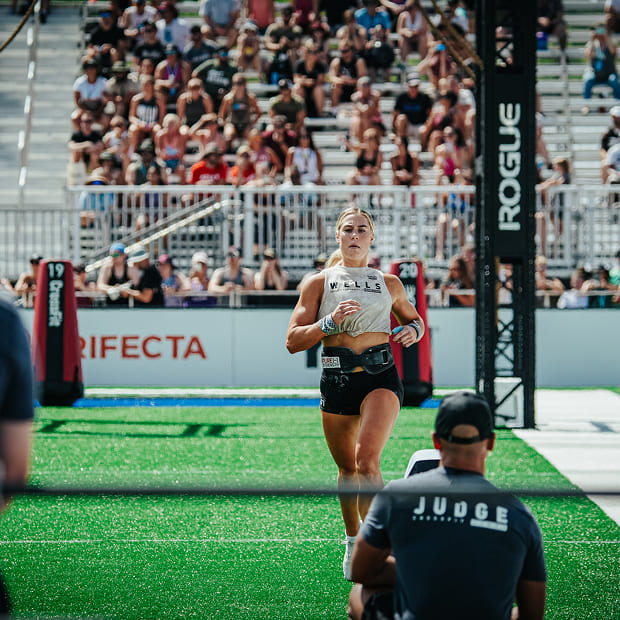
Every HYROX® division requires 100 Wall Ball repetitions. This applies to Men's Open, Women's Open, Men's Pro, Women's Pro, Doubles, and Relay. The rep count does not change between divisions. What changes is the weight of the ball and the height of the target.
| Division | Reps | Ball weight | Target height |
|---|---|---|---|
| Women's Open | 100 | 4kg | 2.70m |
| Men's Open | 100 | 6kg | 3.00m |
| Women's Pro | 100 | 6kg | 2.70m |
| Men's Pro | 100 | 9kg | 3.00m |
Prior to September 2024, Women's Open required 75 Wall Ball reps rather than 100. This changed at the start of the 2024/25 season and applies to all events from that point. Women now complete 100 reps across all divisions, the same as men. If you have seen 75 reps referenced anywhere, that information is outdated.
The Wall Ball station is Station 8, the final workout station in HYROX. Athletes arrive at it after 8km of running and seven prior stations. At that point, 100 squats below parallel while throwing a weighted ball overhead is not a straightforward task.
This is a deliberate design choice. The Wall Ball station rewards athletes who have paced the race well and managed their legs across the earlier stations. After completing 100 Wall Balls, athletes proceed directly to the Finisher Stage. There is no Run 9. The Wall Balls are the last thing you do before you are done.
For a full breakdown of all eight stations and how the race is structured, the HYROX stations guide covers everything in detail.
Every rep counts only if it meets the movement standards. Given the volume, understanding them before race day matters.
If the athlete breaches any of these standards, that repetition is a no-rep. There are no warnings at the Wall Ball station. Every rep is either valid or it is not.
Squat depth boxes may be used at the judge's discretion to assist in assessing whether a racer's squat meets the required depth. They cannot be requested by a racer and are not to be used for resting.
Optimize your performance, accelerate your recovery and prepare your body with personalized mobility training.
Efficient technique across 100 reps matters more at this station than at almost any other. By Station 8, the legs are carrying significant accumulated fatigue. Every wasted movement adds up.
Generate power from the legs, not the arms. As you stand out of the squat, drive through the legs and use that momentum to propel the ball upward. The arms guide the ball to the target; they should not be launching it independently. Athletes who rely on arm strength fatigue their upper body quickly and lose rhythm in the back half of the reps.
Catch the ball into the descent. Rather than catching the ball while standing tall and then squatting down with it, aim to catch the ball as you begin descending into the next squat. This creates a continuous, efficient movement rather than two separate phases, and reduces the total energy cost per rep.
Positioning at the wall. Standing too close to the wall causes the ball to rebound quickly and disrupts timing. Standing too far away means throwing harder to reach the target. Find a position roughly one arm's length from the wall and maintain it throughout. Consistency of position supports consistency of rhythm.
Eyes on the target. Fixing your gaze on the center of the target helps ensure every throw lands in the strike zone and keeps your posture upright through the squat.
100 reps at Station 8 is not the moment to go all out from the start. Athletes who sprint through the first 30 or 40 reps typically find the last 30 significantly harder and slower than if they had started at a controlled pace.
A block approach works well for most athletes: complete a set number of reps (10 to 20 depending on fitness level), take a brief deliberate rest of a few breaths, then continue. Planned pauses are more efficient than reaching the point where an unplanned stop becomes necessary. The goal is to maintain a consistent rhythm through all 100 reps, not to go fast early and slow down later.
Where digital targets are in use, the system automatically counts valid reps and no-reps in real time. Athletes can only proceed to the Finisher Stage once the interface confirms 100 valid reps.
In Doubles, both partners share the 100 reps using a You Go I Go format. One partner works while the other waits in the marked area under the rig without obstructing other athletes. Partners can switch at any point. The ball must either be handed between partners or allowed to drop to the floor before the next partner picks it up. A flying transition where one partner throws to the target and the other catches in the squat and continues directly is not permitted.
In Relay, the Relay Member assigned to Station 8 completes all 100 reps alone. Once finished, all four team members reunite at the Wall Ball station and run to the Finisher Stage together to cross the line as a team.
The Wall Ball station demands squat depth under fatigue across 100 repetitions. The most common source of no-reps is not insufficient strength but insufficient mobility: athletes who cannot consistently reach below parallel when their legs are tired.
Three distinct limiters contribute through different mechanisms.
Ankle dorsiflexion range determines how far the tibia can travel over the foot during the squat; limited ankle range restricts forward knee travel and forces the athlete to either lift the heel or reduce depth.
Hip joint flexion range limits how far the hip can close at the bottom of the squat.
Hamstring length affects the ability to maintain anterior pelvic tilt at depth; short hamstrings pull the pelvis into posterior tilt, causing the lower back to round rather than the hips to descend.
Each requires different training work.
Before the race, targeted activation helps prepare the hips, ankles, and thoracic spine for the squat and overhead demand. The pre-race activation guide covers the full warm-up sequence for race day. Hip mobility work is particularly relevant for this station given how directly hip flexion range affects squat depth.
After the race, the quads, hip flexors, and shoulders carry significant accumulated load from 100 loaded squats and throws following a full race. The post-race recovery guide covers what to do in the hours after finishing. Thigh and hip flexor stretches are a useful starting point for lower-body recovery specific to this station.
Mobility exercises addressing ankle dorsiflexion, hip flexion range, and hamstring length target the three distinct factors that limit squat depth under fatigue. GOWOD builds personalized routines based on your individual movement profile, so the work you do between races can better target what your body actually needs rather than following a generic program.
You’re only 3 steps away from unlocking your full potential.