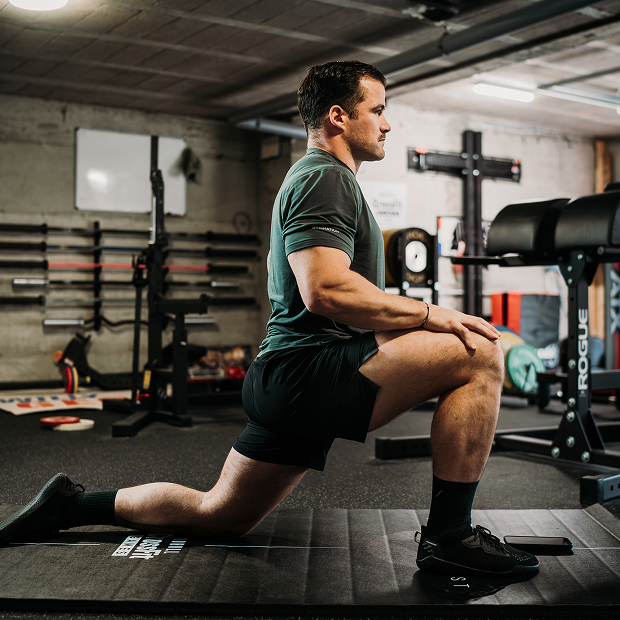
Shoulder tightness is common in athletes and active people, especially if you train strength, overhead movements, or sports requiring rotation and control. Limited shoulder mobility can restrict performance, reduce overhead range, and increase the demands placed on the neck, ribs, and upper back.
This guide brings together seven of the best shoulder mobility exercises, selected by GOWOD mobility specialists, to help you move more freely and support consistent training. Each movement is supported with video guidance so you can follow along safely and effectively.
Try these stretches to improve shoulder mobility
The shoulder is a highly complex joint biomechanically, and it is responsible for many aches, pains, and discomforts. Not only is it useful in everyday life, but if it lacks mobility, it can prevent proper sports technique and even lead to compensations in the neck or the elbow.
Whether you practice swimming, CrossFit, gymnastics, or triathlon, you must take care of your shoulders, and here are the 7 best shoulder mobility exercises for you:
Active hinge: active movement to improve shoulder flexion and thoracic extension.
The bird: helps release tension at the front of the shoulder and works on internal rotation.
Medium pec stretch: releases the pectorals to increase the range of motion.
Side to side: works on the front of the shoulder, the pectorals, and the biceps.
Manual triceps stretch: releases the back of the shoulder and increases flexion.
Scap mobilization: focuses on the often forgotten scapula, key to the shoulder complex.
Blackburn: actively strengthens the scapular stabilizers.
Exercise 1/7: active hinge
Focus
Details
Timing
Repeat for 1 min
Stimulus
Tension in the shoulders and at the back of the thighs
Instructions
• Place your hands flat against the wall
• Arm stretched out and knees slightly bent
• Stretch and bend the knees at a constant rhythm
Targeted areas
Shoulders, Traps, Lats, Hamstrings
Equipment required
None
Exercise 2/7: the bird
Focus
Details
Timing
Repeat for 1 min
Stimulus
Tension in the shoulders
Instructions
• Hands behind the back
• Hands placed one over the other against the lower back
• Elbows move back and forth with maximum amplitude
Targeted areas
Rotators, Shoulders
Equipment required
None
Exercise 3/7: medium pec stretch
Focus
Details
Timing
Repeat for 1 min
Stimulus
Tension in the pectoral muscle
Instructions
• Elbow at nose height
• Palm flat against the support
• Same-side foot placed one step forward
Targeted areas
Pecs, Shoulders
Equipment required
None
Exercise 4/7: side to side
Focus
Details
Timing
Repeat for 1 min
Stimulus
Stretching at your shoulders and pectoral
Instructions
• Stretch arms out to one side and flex on the other
• Keep arm and shoulder on the ground
• Slow and controlled arm-to-arm transitions
Targeted areas
Shoulders, Pecs, Biceps
Equipment required
None
Exercise 5/7: manual triceps stretch
Focus
Details
Timing
Repeat for 1 min
Stimulus
Arm stretch
Instructions
• Place your hand flat on your back as low as possible
• Pull your elbow inwards and downwards with your opposite hand
• Tightened abdominals
Targeted areas
Triceps, Shoulders
Equipment required
None
Exercise 6/7: scap mobilization
Focus
Details
Timing
Repeat for 1 min
Stimulus
Upper back and shoulder tension
Instructions
• Assume a four legged position with hands flat on the ground
• Extend arms
• Move your chest up and down between your shoulders
Targeted areas
Shoulders
Equipment required
None
Exercise 7/7: blackburn
Focus
Details
Timing
Repeat for 1 min
Stimulus
Tension in your upper back and shoulders
Instructions
• While lying down, place toes on the ground, and squeeze lumbar
• Position 1: arms extended
• Position 2: arms backwards, shoulder blades squeezed
Targeted areas
Traps, Shoulders, Lumbar
Equipment required
None
Understanding shoulder tightness
Shoulder discomfort and restriction are common across training styles. Whether you lift, swim, climb, or play field sports, the shoulders are responsible for a wide range of motion and are easily affected by daily habits such as sitting, screen use, and repetitive movements.
Common contributors to shoulder tightness include:
Limited thoracic mobility.
Tight pectorals or biceps.
Weak or underactive scapular stabilisers.
Repetitive overhead training.
Poor movement coordination between the ribs, the shoulder blade, and the upper arm.
Improving mobility in these areas can support more efficient movement and reduce the chance of overload in surrounding tissues.
Anatomy and performance links
The shoulder is a complex joint involving the glenohumeral joint, scapula, clavicle, and thoracic spine. Efficient movement depends on how well these structures collaborate.
Key regions influencing shoulder mobility:
Pectorals influence anterior tightness and external rotation.
The latissimus dorsi can restrict shoulder flexion.
Triceps affect the overhead lockout.
The rotator cuff supports stability through rotation.
Scapular stabilisers dictate joint positioning and control.
Athletes often notice improved overhead positions, reduced pinching sensations, and better pressing or pulling mechanics when these areas move freely.
Common causes of shoulder tightness and relevant mobility focus
Issue
Possible contributor
Mobility focus
Restricted overhead movement
Tight lats or triceps
Active hinge, manual triceps stretch
Pinching at the front of the shoulder
Tight pecs or anterior shoulder tissues
Medium pec stretch, side to side
Poor stability overhead
Weak scapular stabilisers
Blackburn, scap mobilization
Difficulty with internal rotation
Tight anterior tissues
The Bird
Rounded posture
Tight pecs and weak scapula
Medium pec stretch, Blackburn
How shoulder mobility supports training
Improved shoulder mobility is commonly used to:
Support safer overhead lifting.
Enhance pressing and pulling strength.
Improve swimming mechanics.
Support throwing and rotational sports.
Reduce reliance on compensatory neck or lower back movements.
Improve movement comfort during daily tasks.
Consistent mobility work tends to produce the best long-term improvements.
Recovery ideas to pair with mobility
Light soft-tissue work on the pecs and lats.
Gentle thoracic extension drills.
Warm-up activation work for the rotator cuff.
Scapular control drills, such as wall slides.
Balanced strength training for both pushing and pulling patterns.
These practices often support tissue recovery and help maintain movement gains.
FAQs
What causes shoulder tightness in active people? Shoulder tightness often comes from a mix of training volume, poor posture, limited thoracic mobility, and tight tissues around the pecs, lats, and biceps.
How often should I do shoulder mobility exercises? Most people benefit from 5–10 minutes of mobility work three to five times per week, depending on training demands.
Can mobility work help with overhead movements? Yes. Improving shoulder flexion, thoracic extension, and scapular control often supports safer and more efficient overhead positions.
Why does my shoulder pinch during pressing? This can happen when the shoulder sits forward due to tight pectorals or limited scapular movement. Mobility work may help reduce this discomfort.
Can these exercises be used before and after training? Yes. Use active drills like Active Hinge or Blackburn before training, and slower stretches like the medium pec stretch after training.
UNLOCK YOUR BODY
Start your journey to better mobility
You’re only 3 steps away from unlocking your full potential.
Download the GOWOD App
Take your assessment
Improve your mobility one stretch at a time with GOWOD Premium