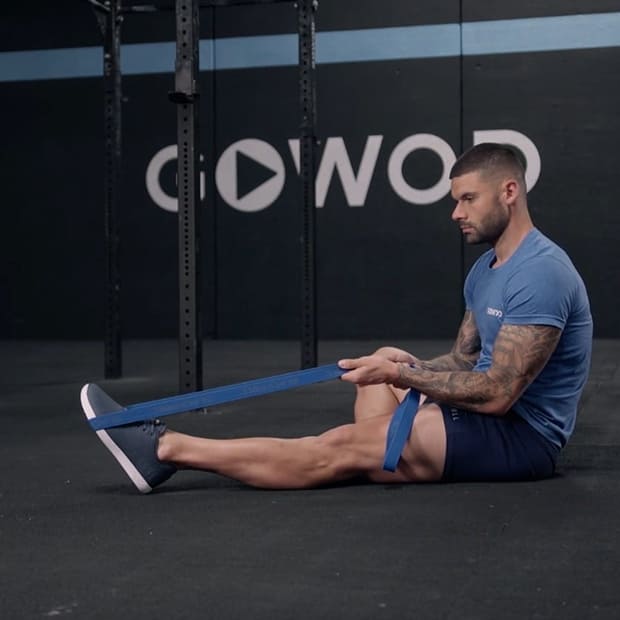
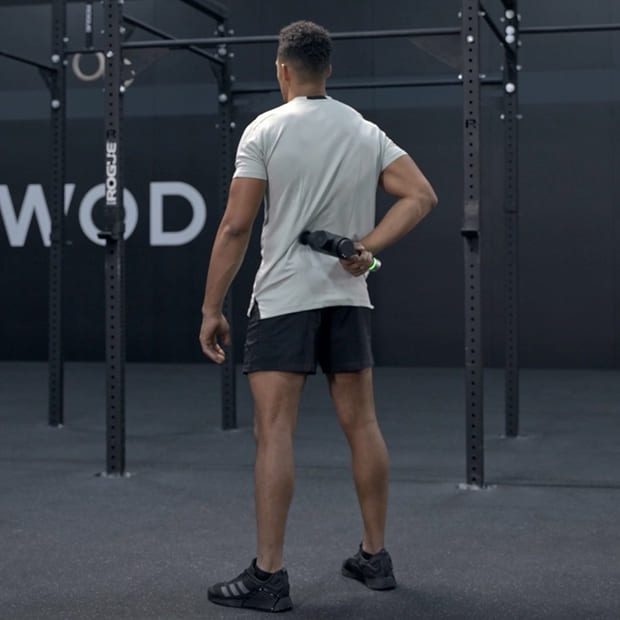
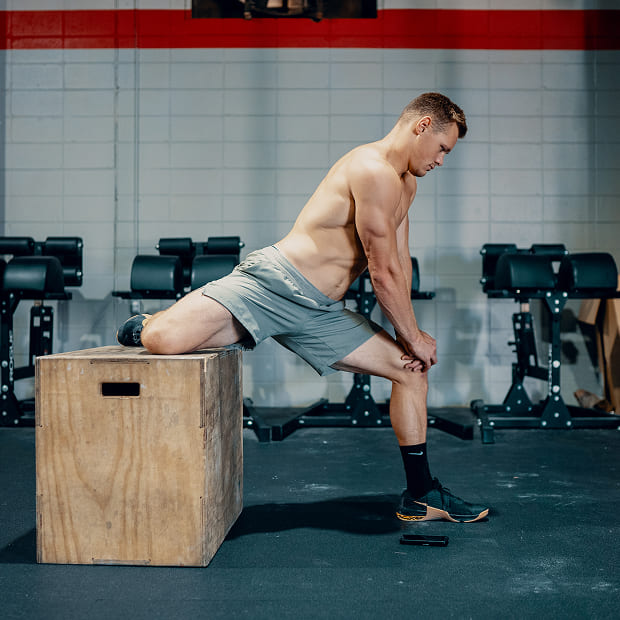
If your heels lift as you sink into a squat, or your calves feel tight every time you go for a run, your ankles are a good place to look. Squatting, lunging, climbing stairs and running all rely on your shin moving forward over your foot, a movement called ankle dorsiflexion. When that range is limited, the body may borrow the missing range elsewhere, for example by lifting the heels, letting the knees drift inward or leaning the trunk further forward.
This beginner routine works on that movement with five simple exercises. It starts with a stretch and a self-massage for the calves, then moves on to three active exercises that take the knee forward over the foot. You’ll need a foam roller and a wall, and the routine takes as little as five minutes.
The routine progresses from the calf muscles to the ankle joint itself, so each exercise builds on the previous one. Work through them in order:
Take our FREE mobility and flexibility test to identify your strengths and areas for improvement. In minutes, get a detailed breakdown of each body zone with insights and personalized guidance to progress.
The movement this routine works on is called dorsiflexion: bringing the shin forward over the foot, or the foot up toward the shin. You need it every time your knee moves forward while your heel stays down, from the bottom of a squat to the moment your foot is under you in a running stride.
When dorsiflexion is limited, the body compensates. The heels lift, the feet turn out, or the knees cave inward to find more depth. For a broader look at why this matters, read our guide to improving ankle mobility.
Three structures play the biggest role in how far your knee can travel forward:
| Area | Role at the ankle | How restriction can show up | Exercises in this routine |
|---|---|---|---|
| Gastrocnemius (upper calf) | Points the foot down. It crosses both the knee and the ankle. | Tightness felt most with the knee straight, such as at the back of the leg in a standing calf stretch. | Wall-assisted calf stretch, calf roll |
| Soleus (lower, deeper calf) | Points the foot down. It crosses only the ankle and works hard during walking and running. | Limits how far the knee travels forward when it is bent, such as at the bottom of a squat or lunge. | Ankle mobilization, assisted ankle mobilization, ankle lunges |
| Ankle joint | The hinge where the shin meets the foot. | The heel lifts, or the knee stops moving forward before the calf feels any stretch. | Ankle mobilization, assisted ankle mobilization, ankle lunges |
The difference between the two calf muscles explains the shape of this routine. Because the gastrocnemius crosses the knee, it’s stretched most with the leg straight, as in the wall-assisted calf stretch. The soleus doesn’t cross the knee, so it’s challenged when the knee bends and moves forward, which is the position used in the three ankle exercises.
This routine uses three different types of work, each with a different job:
That last group is what mobility means: range you can move through and control under your own bodyweight. For a fuller explanation, see our guide to what mobility training is and how it differs from stretching.
A few simple habits will help every exercise do its job:
Short, regular sessions work better than an occasional long one. All five exercises suit daily practice, so doing the routine on most days of the week, even at one minute per exercise, is a good place to start.
Before a run or a lower-body session, the calf roll and the three active ankle exercises fit well into your warm-up. The wall-assisted calf stretch is a held, passive stretch, so it’s better kept for after training or for rest days.
To build a broader daily habit beyond the ankles, try our 5 beginner stretches to start incorporating into your daily routine. If your ankles feel stiffest first thing, our article on stiff ankles in the morning has more ideas.
Once these exercises feel easy, it’s time to take the ankle into deeper, more demanding positions. You’re probably ready to progress when:
At that point, the Advanced Ankle Mobility Routine builds on this base. It adds dynamic calf work, deep squat positions and loaded ankle exercises with a band and a weight.
Our approach starts with an individual assessment. The mobility test assesses your ankles alongside other key areas, so your routines focus on what is actually limiting your movement rather than on a generic routine.
Why do my heels lift when I squat?
Limited dorsiflexion is a common reason. If the knee can’t travel far enough forward over the foot, the heel lifts to let you sink lower. Other factors can play a part too, such as stance width and how your hips move, so it’s worth looking at the whole squat.
Do I need any equipment?
A foam roller for the calf roll, and a wall for the wall-assisted calf stretch and assisted ankle mobilization. Ankle mobilization and ankle lunges need no equipment at all.
Can I do this routine every day?
Yes. All five exercises suit daily practice, and short, regular sessions tend to work better than occasional long ones.
Is ankle mobility the same as calf flexibility?
No. Calf flexibility is the extent to which the calf muscles can passively lengthen. Ankle mobility is how far you can actively move the knee forward over the foot, and control it there. This routine works on both.
How long does it take to improve ankle mobility?
Many people notice a difference within a single session, which mostly reflects greater comfort with the position. Lasting improvement builds with consistent practice over several weeks.
A beginner routine is a great place to start. A personalized approach goes further by focusing on what is actually limiting your ankles.
GOWOD analyzes your mobility, identifies your restrictions, and builds routines around your body and your training. A structured plan makes the difference, whether you want to squat deeper with your heels down, run more comfortably, or simply move more freely day to day.
With GOWOD, you get:
Download GOWOD now and start improving the way you move.
You’re only 3 steps away from unlocking your full potential.