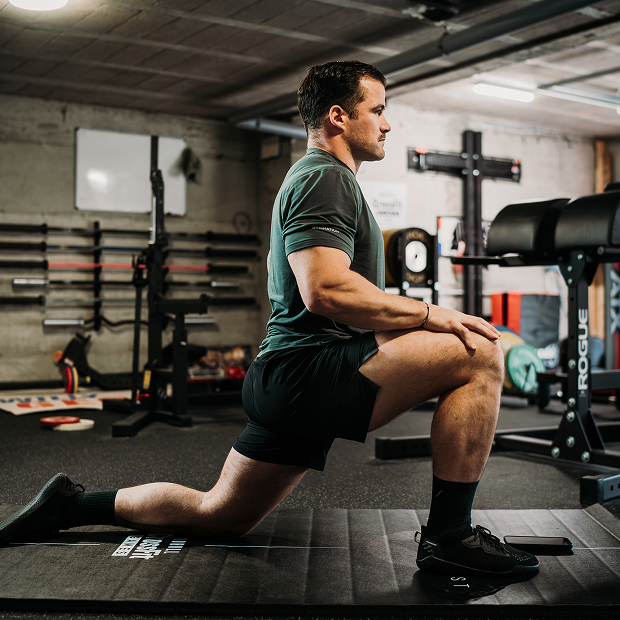
If you drop into a deep hamstring stretch or hold a low lunge for longer than usual, and your leg starts trembling, it's not a weakness, and it's not necessarily a sign that anything is wrong. In most healthy people, this is a normal response to an unfamiliar or demanding position rather than a sign that something is wrong. Your nervous system and muscles are adapting to a task they may not be accustomed to.
When you hold a stretch, especially near your current end range, the muscles around that joint aren't just passively lengthening. They're working to control the position and keep you stable. That control task is a genuine strength demand, and it's one most people rarely train directly.
Trembling during a stretch seems to stem from a mix of factors in your muscles and nervous system, not just a single cause.
There's a fatigue component. To hold a steady position, your nervous system recruits motor units (groups of muscle fibers controlled by a single nerve) and cycles between them to share the workload. When a muscle is unaccustomed to holding tension in that specific range, as fatigue develops, fluctuations in motor unit recruitment and sensorimotor feedback become more pronounced, making force production less steady and resulting in visible tremor.
There's also a reflex component, though it works a little differently than you might expect. Muscle spindles, sensory receptors inside the muscle that detect how fast and how far a muscle is lengthening, can trigger a reflexive contraction (the stretch reflex, sometimes called the myotatic reflex) when a stretch is applied quickly. This reflex matters more during bouncy or fast stretching. During a sustained stretch, ongoing sensory feedback from the muscles and joints continues to influence motor control, which may contribute to the small fluctuations in force perceived as trembling.
Your nervous system's general state of alertness may also play a small part, similar to how you might shiver when you're cold or nervous. Holding an unfamiliar or intense stretch is thought to increase sympathetic nervous system activity, which could increase motor neuron excitability and make a mild tremor more noticeable, though this specific link during stretching is more of an inference than a proven fact.
For most people, in most stretches, no. A mild trembling sensation that fades once you ease off the stretch or build greater tolerance, motor control, and strength in that position over time is a normal training response, not damage occurring.
That said, a few signs point to something that needs more attention than "keep stretching":
Any of these warrants backing off and checking in with a physiotherapist rather than pushing through, since they point toward a possible nerve or joint issue rather than ordinary neuromuscular fatigue.
Take our FREE mobility and flexibility test to identify your strengths and areas for improvement. In minutes, get a detailed breakdown of each body zone with insights and personalized guidance to progress.
None of these is about eliminating trembling entirely; some tremor is a normal part of training an unfamiliar range. They're about making sure it stays manageable and productive rather than something that derails your session.
Back out of the stretch by an inch or two, just enough that the trembling settles into a steady hold instead of an uncontrolled shake. Staying in a position you can actually hold with some control, even if it's less deep than your absolute limit, allows the muscles responsible for controlling that joint position to work more effectively while improving neuromuscular control.
Add short, active holds in that range rather than relying only on passive ones. For example, actively lifting and holding your leg a few inches into the stretch under your own muscular effort, rather than using a strap or gravity to get you there. Even 10 to 20 seconds of controlled active holding, repeated several times, can help develop strength and control in that end range beyond what passive stretching alone is likely to provide. This follows the same principle described in 5 Stretches to Help With Tight Hamstrings and Improve Mobility, where deeper hamstring positions may be more likely to challenge strength and motor control in some individuals.
Slow down your exhale rather than holding your breath through the hold. A longer exhale may promote relaxation by increasing parasympathetic activity and reducing overall physiological arousal, which could make normal physiological tremor feel less pronounced and which may reduce the perception or intensity of physiological tremor in some people, although this specific effect during stretching has not been firmly established.
Five to ten minutes of light movement, such as walking, cycling, or dynamic leg swings, increases muscle temperature, improves neuromuscular readiness, and enhances the mechanical properties of the muscle-tendon unit before deeper static stretching. Stretching without a general warm-up may make deep positions feel less comfortable and harder to control, although its specific effect on trembling has not been clearly established.
Training right at your absolute end range every session keeps those stabilizing muscles at the edge of their current capacity, with little room to adapt before fatigue takes over. Instead, spend most sessions working an inch or two short of your limit, where you can hold the position with control, and save a genuine push to your current maximum for once every week or two. This allows strength, motor control, and tolerance to improve progressively between more demanding sessions.
Understanding why your legs shake is one thing. Having the right exercises to make progress is another. The GOWOD app offers more than 300 mobility and stretching exercises. So you’re no longer limited to repeating the same movements over and over again.
Rather than choosing your exercises at random, the Mobility Test assesses your current mobility profile and then builds a personalized routine based on your mobility score and the sport you play. The goal is to prioritize the exercises that are most relevant to your current needs.
This personalization is important. A runner’s needs aren’t necessarily the same as those of a soccer player or a CrossFit athlete. Furthermore, a simple, generic list of stretches can’t tell whether your main limitation is in your hips, hamstrings, calves, or ankles.
As your mobility profile evolves through successive assessments, GOWOD updates your recommendations so they continue to align with your current needs, rather than having you repeat the same exercises indefinitely. This personalized approach is based on your Mobility Test, your Mobility Focus, and the biomechanical demands of your sport.
Does shaking mean I'm stretching too hard?
Not necessarily. It usually reflects an unfamiliar demand on the muscles and neuromuscular control required to maintain that joint position, rather than an unsafe level of intensity. If it's paired with sharp pain or numbness, that's a different signal and worth easing off for.
Will the shaking go away as I get more flexible?
It typically becomes less noticeable as your strength, motor control, and tolerance improve in that range, although you may still notice trembling when exploring a genuinely new range of motion.
Should I stop stretching as soon as my leg starts shaking?
Not automatically. Mild trembling that settles when you slightly reduce the intensity is generally a normal neuromuscular response to a challenging position. Stop and reassess if the shaking is accompanied by sharp pain, numbness, or a sense of the joint becoming unstable.
Managing trembling productively comes down to structured, progressive training, not guesswork about how far to push. The GOWOD app builds personalized mobility programs designed to help you progressively improve both range of motion and control based on your mobility profile, sport, and ongoing assessments, helping you develop strength and control in the ranges that are most relevant to your current mobility profile.
Download GOWOD and start building mobility that's designed to improve both your range of motion and your ability to control it.
You’re only 3 steps away from unlocking your full potential.